


An acoustic guitar pickup solves a simple problem in several very different ways: it turns some part of your guitar’s vibration into an electrical signal that an amp, PA, interface, or pedalboard can use.
The important part is some part.
An undersaddle pickup listens to pressure and vibration around the saddle. A soundboard transducer listens more directly to the guitar’s vibrating top or bridge plate. A magnetic pickup senses the strings. An internal microphone captures sound moving through the body cavity.
Those differences shape nearly everything that comes later — amplified character, feedback resistance, installation, onboard controls, maintenance, and how the guitar reacts when the stage gets loud.
So don’t start with the brand name.
Start with the pickup type.
The Four Main Ways to Amplify an Acoustic Guitar
Most aftermarket acoustic systems fall into four broad families, with hybrid designs combining two of them.
| Pickup Type | What It Primarily Senses | Stage-Volume Strength | Installation | Reversibility | Typical Best Fit |
|---|---|---|---|---|---|
| Undersaddle piezo | Saddle pressure and vibration | Strong | Moderate to involved | Usually partly permanent | Gigging, predictable stage rigs |
| Soundboard / bridge-plate transducer | Guitar-top vibration | Moderate | Internal mounting | Varies by system | Fingerstyle, body detail, natural response |
| Magnetic soundhole | Steel-string movement | Strong | Very easy to moderate | Often highly reversible | Loud stages, pedals, simple retrofits |
| Internal microphone | Air and body resonance | Lower on its own | Internal mounting | Varies | Quiet stages, detailed acoustic character |
| Hybrid system | Two sensing methods | Highly configurable | Usually more involved | Varies | Players balancing realism and stage control |
That table is the map. The details explain the compromises.
Undersaddle Piezo Pickups
The classic undersaddle transducer sits beneath the saddle in the bridge slot. String energy passes through the saddle into the sensing element, which converts those mechanical changes into an electrical signal.
This design has become common for a reason. It gives the player a consistent, direct source that generally behaves well when stage volume rises.
But installation matters enormously.
The saddle needs to contact the pickup evenly. Poor fit, an uneven saddle bottom, or incorrect pressure across the element can create weak-string response and balance problems. Fishman’s current Matrix Infinity VT installation documentation, for example, requires saddle preparation to compensate for the pickup’s added height and specifies a flat saddle bottom; its endpin preamp installation also requires a 15/32-inch jack hole. Fishman recommends professional installation for the system. Fishman Matrix Infinity installation guide.
That is not the same job as clipping a pickup into a soundhole.
Undersaddle systems also have the tonal reputation every acoustic player has heard: piezo quack. That description gets thrown around too freely. The pickup architecture can emphasize the immediate attack of the string, but saddle fit, preamp design, EQ, playing dynamics, downstream impedance, and the rest of the signal chain all influence the final result.
A good undersaddle system is not automatically harsh.
And a bad installation can make an excellent one sound much worse than it should.
Soundboard and Bridge-Plate Transducers
A soundboard transducer moves the sensing point away from direct saddle pressure and toward the vibrating structure of the guitar.
That changes the information reaching the pickup.
Instead of focusing so heavily on what happens at the saddle, these systems capture more of the bridge plate, top, and body movement surrounding each note. That often appeals to players who want the amplified signal to preserve more of the guitar’s physical response — especially fingerstyle players whose right hand creates far more than simple string vibration.
The K&K Pure Mini is a useful example of the architecture. It uses three passive transducers installed on the bridge plate inside a steel-string acoustic guitar. K&K specifies direct mounting with superglue gel for optimum performance, while also stating that the system can be carefully removed, although the pickup itself may be damaged during removal. K&K Pure Pickup.
That detail reveals an important distinction.
“Internally mounted” does not automatically mean “permanent,” and “removable” does not automatically mean “zero consequence.”
Installation method matters.
Soundboard systems can also capture more physical activity from the guitar. For a delicate fingerstyle player, that sensitivity can feel alive and responsive. For somebody striking the top aggressively while standing in front of loud monitors, the exact same sensitivity becomes part of the feedback and handling equation.
Neither outcome makes the technology better or worse.
It makes the application different.
Magnetic Soundhole Pickups
A magnetic acoustic pickup works much more like the magnetic pickup on an electric guitar. Magnets and coils respond to the movement of ferromagnetic strings rather than directly sensing the acoustic movement of the guitar’s top.
That gives magnetic soundhole pickups a useful advantage: the pickup is focused heavily on the strings.
They are often straightforward to install, resistant to many of the handling problems that affect body-sensitive systems, and comfortable in rigs involving effects pedals, loud monitoring, or electric-style signal processing.
They are also among the least invasive ways to make an acoustic guitar stage-ready.
Seymour Duncan’s passive Woody Single Coil, for example, mounts directly in a standard soundhole without guitar modification, uses an external cable, and can be removed again. Because it is magnetic, Seymour Duncan specifies it for steel-string acoustic guitars rather than nylon-string instruments. Seymour Duncan Woody Single Coil.
That makes a removable magnetic pickup especially interesting if the guitar itself is the thing you do not want to alter.
There is a tradeoff.
A magnetic pickup is not listening to the entire guitar in the same way a microphone or bridge-plate transducer does. Much of what you hear acoustically from the top, air cavity, and body becomes less dominant in the electrical signal.
Some players hear that as less “acoustic.”
Others hear a controllable, musical signal that survives the gig.
Context wins again.
Internal Microphones
An internal microphone approaches the guitar from the other direction.
Instead of trying to infer the instrument’s voice from pressure, magnetism, or surface vibration, the microphone captures acoustic energy inside the body.
That can preserve details other pickup systems struggle to reproduce: air, resonance, body movement, pick noise, finger noise, and the broader envelope around the note.
It also captures more of the things that make microphones difficult onstage.
Sound from monitors and PA speakers can enter the guitar body, excite resonances, and return to the microphone. As gain increases, the usable margin before feedback often becomes more important than the extra acoustic detail.
This is why internal microphones make the most sense when you stop asking whether they are “more natural” and start asking where they will be used.
A quiet solo set and a loud full-band stage are two different engineering problems.
Hybrid Pickup Systems Combine Two Different Sources
Hybrid systems exist because no single sensing method wins every category.
Pair an internal microphone with an undersaddle element, for example, and the player gets two different kinds of information. The microphone can provide body and air. The pickup can supply a stable foundation when volume increases.
The blend then becomes part of the rig.
LR Baggs’ Anthem concept illustrates the principle: its design combines an undersaddle Element pickup with an internal Tru-Mic rather than asking one source to do every job. LR Baggs describes the crossover arrangement as using the pickup for the lower frequencies while the microphone handles much of the midrange and treble in its mic-oriented blend. LR Baggs Anthem discussion.
That flexibility costs something.
Hybrid systems add components, wiring, setup decisions, and usually more installation work. They can also add controls and batteries that need somewhere to live inside the guitar.
For the right player, the extra complexity buys useful control.
For somebody who plays three coffeehouse gigs a year, it may solve a problem they never had.
Active vs. Passive Acoustic Pickups
“Active” and “passive” describe more than whether the pickup has a battery.
A passive pickup produces its output without an onboard powered preamp. That keeps the guitar electrically simple, but the pickup’s impedance and output characteristics place more responsibility on whatever comes next in the signal chain.
An active system includes powered electronics that condition the signal before it leaves the instrument. Depending on the design, that can provide buffering, gain, EQ, tone controls, blending, or other processing.
Neither architecture is inherently better.
A passive K&K Pure Mini, for instance, operates without a battery and can feed an appropriate downstream preamp or input. K&K itself recommends a matched preamp when a player needs greater gain before feedback or more signal control. K&K Pure Pickup.
Fishman’s Matrix Infinity VT takes the active route. It combines its undersaddle pickup with an endpin-mounted preamp, soundhole volume/tone control module, voicing options, and a 9-volt power supply. Fishman Matrix Infinity VT.
Those are different system philosophies, not quality tiers.
When an External Preamp Matters
Passive pickups make the next device particularly important.
The input impedance of the preamp, DI, amplifier, or interface interacts with the pickup itself. A poor match can change frequency balance, reduce level, or produce a signal that feels thin and difficult to shape.
That does not mean every passive pickup needs another expensive box.
It means the pickup and input form a system.
If your passive pickup sounds completely different when moved between an acoustic amp, mixer, interface, and pedalboard, investigate the input stage before deciding the pickup itself is the problem.
Installation Can Matter as Much as Tone
Pickup shopping often starts with sound clips.
Installation deserves equal attention.
A pickup you love in a demo becomes a poor choice if installing it requires modifications you do not want on that particular guitar.
Think about installation in levels.
Level 1 — removable: A magnetic soundhole pickup with an external cable can go in and come back out without drilling. Seymour Duncan’s Woody is one current example. Seymour Duncan Woody Single Coil.
Level 2 — minor permanent modification: Running the output through an endpin jack often means enlarging the existing endpin or strap-button hole.
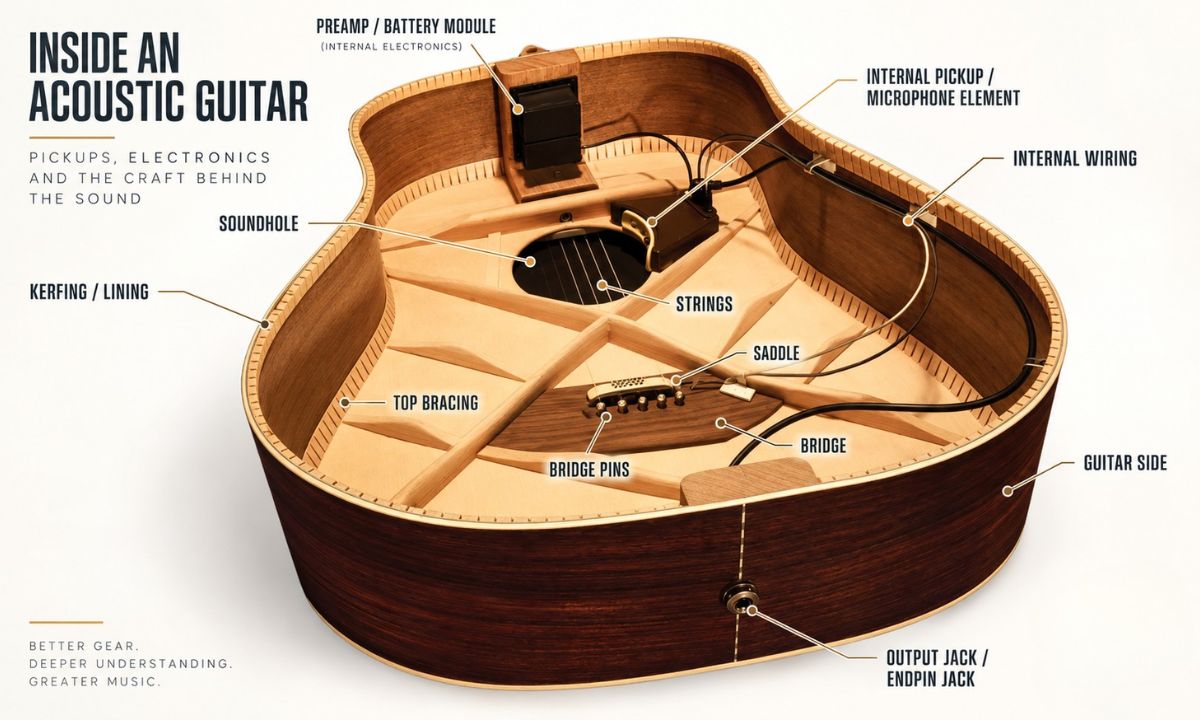
Level 3 — internal mounting: Bridge-plate transducers, controls, batteries, cable clips, or microphones need secure placement inside the body.
Level 4 — bridge and saddle work: An undersaddle pickup requires correct fit beneath the saddle. Maintaining action can require removing material from the saddle itself. Fishman Matrix Infinity installation guide.
Level 5 — body modification: Some onboard systems use side-mounted control panels that require cutting the guitar’s body.
Those levels are not universal rules for every product.
They are a way to think before drilling.
Valuable and Vintage Guitars Need a Different Threshold
A modern working guitar and a historically important acoustic do not deserve the same installation decision.
On a valuable, collectible, or unusually original instrument, reversibility becomes part of the pickup specification.
A removable soundhole pickup may be less elegant than hidden electronics, but that compromise looks very different when the alternative involves enlarging holes, altering a saddle, bonding components internally, or cutting the side of an instrument whose originality matters.
Get an experienced repairer involved before making irreversible changes.
The pickup can always be changed later.
Original wood cannot.
Which Pickup Type Fits the Way You Actually Play?
The strongest pickup choice starts with the gig.
Not the product page.
Solo Fingerstyle and Quiet Rooms
Quiet stages give you room to prioritize detail.
Soundboard transducers, internal microphones, and blended systems become particularly attractive because the signal can retain more of the instrument’s physical movement without immediately fighting high monitor levels.
Fingerstyle also produces subtle information outside the fundamental string note — fingertip attack, nail contact, body resonance, and sometimes deliberate percussion.
A pickup sensitive to the guitar’s structure can make those details part of the amplified performance.
Whether that is desirable depends on the player.
Loud Bands and Stage Monitors
Volume changes the priority list.
If the acoustic needs to sit beside drums, electric guitars, stage wedges, and subwoofers, predictable gain becomes more valuable. Undersaddle and magnetic systems are common starting points because their sensing methods are less dependent on capturing the guitar’s internal air movement.
That does not make them feedback-proof.
The guitar body remains a resonant acoustic object, and every stage has its own problems.
But the architecture gives you a different starting position.
Acoustic Players Who Use Pedals
Magnetic pickups deserve special attention when an acoustic rig behaves more like an electric rig.
Compression, overdrive, octave effects, modulation, loopers, and other pedals often reward a strong, predictable string signal. Magnetic designs provide exactly that kind of information.
The compromise is familiar by now: more direct string sensing means less of the complete acoustic body reaches the signal.
For an effects-heavy player, that can be an advantage rather than a loss.
Percussive Players
Percussive acoustic guitar exposes the limits of simple “natural tone” rankings.
If you hit the top, tap the bridge, slap the strings, and treat the guitar body as part of the percussion arrangement, a sensor attached to the vibrating structure may reproduce those gestures far more clearly than a magnetic pickup.
That sounds ideal until every unwanted handling noise becomes clearer too.
The question is not which pickup captures more.
It is which movements you want amplified.
Players Who Do Not Want to Modify the Guitar
Start with the installation requirement.
A removable magnetic soundhole pickup with an external lead can provide a legitimate amplified rig without changing the bridge, drilling an endpin jack, or attaching internal electronics.
That simplicity has value.
It also lets you move the pickup between compatible instruments, experiment before committing to a permanent installation, or preserve a guitar that you would rather leave alone.
Pickup Type Matters More Than the “Best Pickup” Label
There is no useful answer to “What is the best acoustic guitar pickup?” until the guitar and job are defined.
Use this order instead:
- Where are you playing? Bedroom, studio, coffeehouse, church stage, theater, or loud band.
- How much gain do you need before feedback becomes a concern?
- Which part of the acoustic sound matters most? String clarity, body resonance, air, percussive response, or a blend.
- How much modification will you accept?
- Do you need controls on the instrument itself?
- Do you want a battery inside the guitar?
- What will the pickup plug into?
Only then start comparing specific models.
This approach also makes used pickup shopping much easier. Once you know you need a passive bridge-plate transducer rather than an active undersaddle system, half the marketplace stops being relevant.
You can browse acoustic pickups on Resyn with the system type in mind instead of comparing unrelated products by price alone.
Representative Acoustic Pickup Systems Worth Knowing
These are not rankings.
They are useful examples of four different design philosophies.
Fishman Matrix Infinity VT — active undersaddle system. Fishman pairs its Matrix undersaddle element with an endpin preamp, soundhole-mounted volume and tone controls, selectable voicing, and 9-volt power. Professional installation is recommended. It represents the integrated, stage-oriented undersaddle approach well. Fishman Matrix Infinity VT.
K&K Pure Mini — passive bridge-plate transducer. Three pickup heads mount to the bridge plate of a steel-string acoustic. The system requires no battery, while K&K offers or recommends external preamp options for players who need more control or additional gain before feedback. K&K Pure Pickup.
Seymour Duncan Woody Single Coil — removable passive magnetic pickup. It mounts in a standard steel-string soundhole without modifying the guitar and uses an external cable. It is a clean example of the low-commitment magnetic approach. Seymour Duncan Woody Single Coil.
LR Baggs Anthem — hybrid undersaddle and internal-microphone system. The design uses two sensing sources and divides their jobs rather than relying on the microphone alone across the entire frequency range. It illustrates why hybrid systems exist: one source can contribute stability while another adds more body information. LR Baggs Anthem discussion.
Which is best?
Still the wrong question.
Which architecture solves your problem with the fewest unwanted compromises? That’s useful.
Common Acoustic Pickup Mistakes
Buying by brand before choosing the architecture. Every major pickup company makes systems for different problems. Brand loyalty does not turn an undersaddle pickup into a microphone.
Assuming the most acoustic-sounding option automatically wins live. A detailed signal that works beautifully at low volume can become difficult when stage gain rises.
Ignoring the installation. The difference between clipping a pickup into a soundhole and preparing a saddle slot is not minor.
Forgetting the rest of the signal chain. Passive pickups, in particular, depend on the input that follows them.
Cutting into a guitar simply to put controls within reach. External preamps and pedals can sometimes provide the control you need without side-mounted electronics.
Assuming removable means risk-free. Any device contacting a guitar deserves careful installation, especially around delicate finishes and valuable instruments.
Expecting the amplified guitar to sound exactly like your unplugged guitar from the player’s chair. A pickup hears a different version of the instrument than your ears do in a room. Amplification then adds speakers, EQ, gain, placement, and venue acoustics.
That difference is normal.
The goal is a convincing amplified instrument, not an impossible electrical copy of an acoustic event.
A Simple Acoustic Pickup Decision Guide
Start with the biggest constraint.
You want maximum reversibility.
Begin with a removable magnetic soundhole pickup and external cable.
You play with drums and loud stage monitoring.
Start your search around undersaddle and magnetic systems, then evaluate feedback control and tone from there.
You play fingerstyle in quieter environments and want more body information.
Explore bridge-plate transducers, microphone systems, and hybrids.
You want acoustic detail but still need dependable stage gain.
A dual-source or hybrid system gives you more control over the balance.
You use lots of effects.
Consider whether the predictable string-focused signal from a magnetic pickup fits the pedalboard better than a body-sensitive transducer.
You own a vintage, collectible, or personally irreplaceable guitar.
Put reversibility first. Discuss any permanent work with a qualified repairer before changing the instrument.
You already know you want an undersaddle pickup.
Treat installation quality as part of the purchase. A precision-sensitive system deserves precision work.
A pickup is not just an accessory hanging off the end of the guitar.
It becomes part of the instrument’s signal chain — and, with permanent systems, part of the instrument itself.
The Right Acoustic Pickup Matches the Guitar, the Stage, and the Installation
The best choice starts with what the pickup senses, then follows the consequences from there.
A loud-band player may happily trade some body detail for predictable gain. A fingerstyle player may make the opposite decision. Someone protecting an older guitar may accept an exposed cable because drilling one hole is already one hole too many.
That is the useful way to shop.
Choose the architecture whose compromises fit your guitar and the work you actually ask it to do.
