


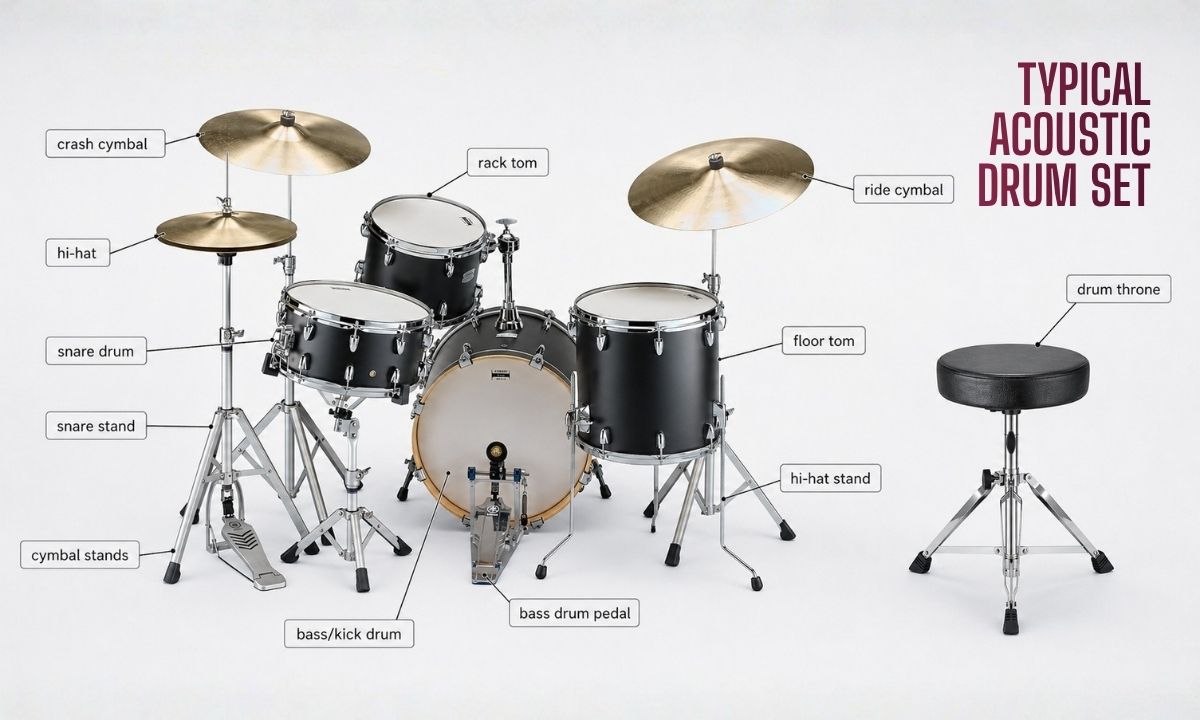
A standard acoustic drum set combines three basic groups of equipment: drums, cymbals, and hardware. The drums usually include a snare, bass drum or kick, and one or more toms. Cymbals commonly include hi-hats, a crash, and a ride. Hardware holds everything in position and gives your feet control over the kick and hi-hats.
That sounds simple until someone calls a kit “five-piece,” lists a shell pack without a snare, or photographs three cymbals beside five drums.
The terminology gets easier once you separate the actual drums from everything surrounding them.
What Are the Main Parts of a Drum Set?
Most acoustic drum sets contain drums, cymbals, hardware, and accessories. Only the drums normally determine whether a kit is described as three-piece, four-piece, five-piece, or another size.
| Part | Category | Basic role | Counts toward kit size? |
|---|---|---|---|
| Snare drum | Drum | Sharp, articulate backbeat and accents | Yes |
| Bass drum / kick drum | Drum | Low-end pulse played with a foot pedal | Yes |
| Rack tom | Drum | Higher-pitched tom used for fills and movement around the kit | Yes |
| Floor tom | Drum | Deeper tom positioned beside the drummer | Yes |
| Hi-hat | Cymbals | Two pedal-controlled cymbals used for timekeeping and accents | No |
| Crash cymbal | Cymbal | Strong accent or transition | No |
| Ride cymbal | Cymbal | Sustained timekeeping and rhythmic patterns | No |
| Bass drum pedal | Hardware | Strikes the bass drum | No |
| Snare stand | Hardware | Supports the snare | No |
| Cymbal stands | Hardware | Support crash, ride, and other cymbals | No |
| Drum throne | Accessory | Drummer’s seat | No |
This distinction matters whenever you’re comparing kits.
A drum set photographed with five drums, three cymbals, six stands, two pedals, and a throne is still generally considered a five-piece drum set, not a seventeen-piece kit.
What Does “5-Piece Drum Set” Actually Mean?
A five-piece drum set normally means five drums.
Yamaha’s Musical Instrument Guide describes a basic five-piece configuration as a bass drum, snare drum, two tom-toms, and a floor tom. The cymbals sit outside that five-piece count.
A common five-piece layout looks like this:
- 1 bass drum
- 1 snare drum
- 2 rack toms
- 1 floor tom
Then the drummer adds cymbals, pedals, stands, a throne, and whatever extra percussion the setup requires.
That last point is important. Drum kits are modular instruments. Two players can both own five-piece sets while using completely different cymbal arrangements, hardware, drum sizes, and mounting systems.
What Is in a 3-Piece Drum Set?
A three-piece kit contains three drums.
One compact configuration uses a bass drum, rack tom, and floor tom, with the snare purchased or selected separately. Another three-piece setup may count the snare and use only one tom.
There is no single law governing every manufacturer’s package.
Treat “three-piece” as a drum count first, then inspect the actual included components.
What Is in a 4-Piece Drum Set?
A common four-piece setup includes:
- bass drum
- snare drum
- rack tom
- floor tom
This stripped-down arrangement is popular because it covers the core voices of a drum set without surrounding the player with extra shells.
But a four-piece shell pack can be configured differently. Yamaha, for example, sells four-piece shell packs that consist of a bass drum, two rack toms, and a floor tom while selling the snare separately.
The number tells you how many drums are included. It does not tell you exactly which drums they are.
What Is in a 5-Piece Drum Set?
The familiar five-piece configuration adds a second rack tom to the standard kick, snare, rack tom, and floor tom setup.
For many beginners, this is the drum-set shape they already recognize:
two smaller toms above the bass drum, one larger floor tom at the side, a snare in front of the player, and the bass drum underneath the rack toms.
It’s versatile without being especially complicated, which explains why five-piece configurations appear so often in beginner and intermediate drum lines.
What Is in a 7-Piece Drum Set?
A seven-piece drum set simply expands the number of drums to seven.
That usually means more toms or another specialty drum added around the core bass-drum-and-snare foundation. Exact layouts vary considerably because larger kits become increasingly personal.
The useful rule stays the same:
Count the drums, then inspect the cymbals and hardware separately.
Snare Drum
The snare drum normally sits directly in front of the drummer and produces one of the most recognizable sounds in the kit.
Its defining feature sits underneath.
A set of metal snare wires rests against the lower, or resonant, drumhead. When the drum is struck, those wires vibrate against the head and create the crisp, buzzing response that separates a snare from a tom.
A lever on the side, commonly called a throw-off or strainer, lets the player engage or disengage the snare wires.
The snare carries an enormous amount of rhythmic responsibility. In many rock, pop, funk, and related grooves, it provides the backbeat that answers the bass drum and locks into the rest of the rhythm section.
It is also one of the most commonly individualized parts of a kit. Drummers routinely own several snares and swap them according to sound, tuning range, shell material, depth, or musical context.
That matters when you’re looking at used gear.
A listing for a drum shell pack may not include the snare shown in a reference photo. Check the item description and included-parts list rather than assuming it comes with the rest of the drums.
Bass Drum or Kick Drum
Bass drum and kick drum usually refer to the same drum when you’re talking about a standard drum set.
It is the large drum positioned on the floor in front of the player. Instead of striking it directly with a stick, the drummer operates a bass drum pedal with one foot. Pressing the pedal drives a beater into the drumhead.
The result is the kit’s low-end pulse.
The bass drum often works closely with the bass guitar to establish the rhythmic foundation of a band. Its deeper voice also creates a strong contrast with the sharper attack of the snare.
Keep the drum and pedal mentally separate when you’re shopping.
The bass drum counts as one of the drums in the kit. The pedal is hardware, and it may or may not be included with a used set or shell pack.
Rack Toms and Floor Toms
Toms, short for tom-toms, fill the tonal space between the snare and bass drum.
They appear in several sizes, so a drummer can move from higher to lower tones around the kit. You hear that movement clearly during fills, transitions, and phrases that travel across multiple drums.
Rack Toms
Rack toms are the smaller toms commonly positioned above the bass drum.
They may attach directly to a bass-drum-mounted holder, connect to cymbal stands through clamps, or hang from a separate drum rack.
Smaller rack toms generally produce higher tones than larger toms, although tuning, heads, shell construction, and other variables also shape the final sound.
On the classic five-piece layout, two rack toms often sit in front of the drummer.
Floor Tom
The floor tom provides the deeper end of the tom family.
Traditional versions stand on three legs beside the drummer. Some modern systems suspend the drum from mounting hardware instead, so “floor tom” increasingly describes its role and size as much as one exact mounting method.
A conventional five-piece kit normally contains one floor tom.
Larger setups can add another, giving the drummer a wider low-register range without changing the basic function of the instrument.
The Three Core Cymbals: Hi-Hat, Crash and Ride
Cymbals are part of the complete drum setup, but they normally do not count toward the advertised number of pieces.
A basic acoustic kit commonly uses three cymbal types: hi-hats, crash, and ride.
Each has a different job.
Hi-Hat
The hi-hat is actually a pair of cymbals mounted face-to-face on a specialized stand.
A foot pedal opens and closes the space between them. That lets the drummer play tightly closed notes, partially open textures, louder open sounds, or close the cymbals with the foot alone.
Hi-hats are one of the main timekeeping voices on a standard kit.
They also demonstrate why the phrase “piece count” can confuse beginners. Two physical cymbals sit on the hi-hat stand, but neither increases a five-piece drum kit to six or seven pieces.
Crash
A crash cymbal provides accents.
Drummers often strike it to emphasize the beginning of a section, punctuate a fill, or create a larger burst of sound than the hi-hat or ride provides during normal timekeeping.
A basic kit may use one crash.
Larger setups often contain several crashes of different sizes or designs, but they remain cymbals rather than counted drums.
Ride
The ride cymbal gives the drummer another primary surface for keeping time.
Compared with the quick punctuation of a crash, a ride is typically used for more continuous rhythmic patterns. Different areas of the cymbal also produce noticeably different responses, especially the bow and bell.
A basic setup usually positions the ride on the opposite side of the kit from the hi-hats, although personal layout always wins over rigid convention.
Other cymbals can expand this palette considerably. Splash, China, stack, effects, and additional crash cymbals all have useful roles, but you do not need them to understand the anatomy of a standard kit.
Drum Hardware: The Parts That Hold and Control the Kit
Drums and cymbals make sound. Hardware makes the setup playable.
The category includes the stands, pedals, mounts, clamps, and mechanical systems that position the instruments around the drummer.
Common drum hardware includes:
- bass drum pedal
- hi-hat stand
- snare stand
- straight cymbal stands
- boom cymbal stands
- tom holders
- mounting arms
- clamps
- floor-tom legs
- drum racks
Hardware can become surprisingly important when you’re comparing used drum sets.
A collection of shells without usable mounts or stands may require additional purchases before you can assemble a complete playing setup. A kit with a full hardware package presents a very different starting point.
The bass drum pedal is the easiest example.
It is essential for playing a conventional kick drum, but it is not part of the drum’s piece count. The same logic applies to the hi-hat stand and the cymbals mounted above it.
Drum Throne, Sticks and Other Essentials
A drum kit needs a few more things before someone can comfortably play it.
The drum throne is the drummer’s seat. Calling it a throne may sound theatrical, but the distinction from an ordinary chair matters because height, stability, and positioning affect how the player reaches the pedals and surrounding drums.
Drumsticks are another obvious necessity, but they are accessories rather than kit pieces.
Depending on the player, the working setup may also include:
- brushes
- mallets
- drum key
- cowbell
- tambourine
- practice accessories
- additional percussion
- electronic pads or triggers
Yamaha notes that drum kits can incorporate other percussion instruments and even electronic drums. That flexibility is part of what makes the drum set less like one fixed instrument and more like a configurable playing system.
Complete Drum Set vs Shell Pack: Know What You’re Looking At
This is where drum terminology starts affecting buying decisions.
A complete drum set and a shell pack are not automatically the same thing.
Yamaha defines a shell pack as a set of drums sold with minimal hardware. Current Yamaha products show just how much the contents can vary. Some shell packs include a snare; others sell the snare, cymbals, pedals, and stands separately.
So never buy from the phrase alone.
If you’re comparing a new or used kit, check whether the listing specifically includes:
- bass drum
- snare drum
- rack toms
- floor tom
- tom mounts
- bass drum pedal
- hi-hat stand
- cymbal stands
- cymbals
- throne
- other clamps or mounting hardware
Photos help, but the written included-item list matters more.
A seller may photograph a shell pack while it is mounted on their personal hardware and surrounded by cymbals that are not actually part of the sale.
This is one reason learning the parts of a drum set becomes useful beyond beginner terminology. Once you can identify each component, you can compare two listings piece by piece instead of treating every collection of drums as an equivalent “kit.”
Browse drums and drum kits on Resyn when you’re ready to see how complete kits, individual drums, cymbals, and related gear are listed in the real marketplace.
Quick Drum Set Parts Reference
| Component | Other name | Main role | Usually counted as a kit “piece”? |
|---|---|---|---|
| Snare drum | Snare | Sharp backbeat, accents, detailed articulation | Yes |
| Bass drum | Kick drum, kick | Low-end pulse played by foot | Yes |
| Rack tom | Mounted tom, hanging tom | Higher tom voice and fills | Yes |
| Floor tom | Floor tom | Lower tom voice | Yes |
| Hi-hat | Hi-hats | Pedal-controlled timekeeping and accents | No |
| Crash cymbal | Crash | Strong accents and transitions | No |
| Ride cymbal | Ride | Sustained timekeeping | No |
| Bass drum pedal | Kick pedal | Operates the bass drum | No |
| Hi-hat stand | Hi-hat hardware | Opens and closes the hi-hats | No |
| Snare stand | Snare basket | Supports the snare | No |
| Cymbal stand | Straight or boom stand | Supports cymbals | No |
| Tom mount | Tom holder | Positions rack toms | No |
| Drum throne | Throne | Drummer’s seat | No |
A Drum Set Makes More Sense Once You Separate the Drums, Cymbals and Hardware
You do not need to memorize every drum accessory to understand a kit.
Start with the five core drum voices: snare, bass drum, rack toms, and floor tom. Then recognize the hi-hat, crash, and ride as the basic cymbal family, with pedals and stands forming the hardware underneath everything.
Once those groups are clear, terms like three-piece, five-piece, shell pack, and complete kit stop sounding like drummer shorthand.
You can see exactly what is there, what is missing, and what the seller is actually offering.
