

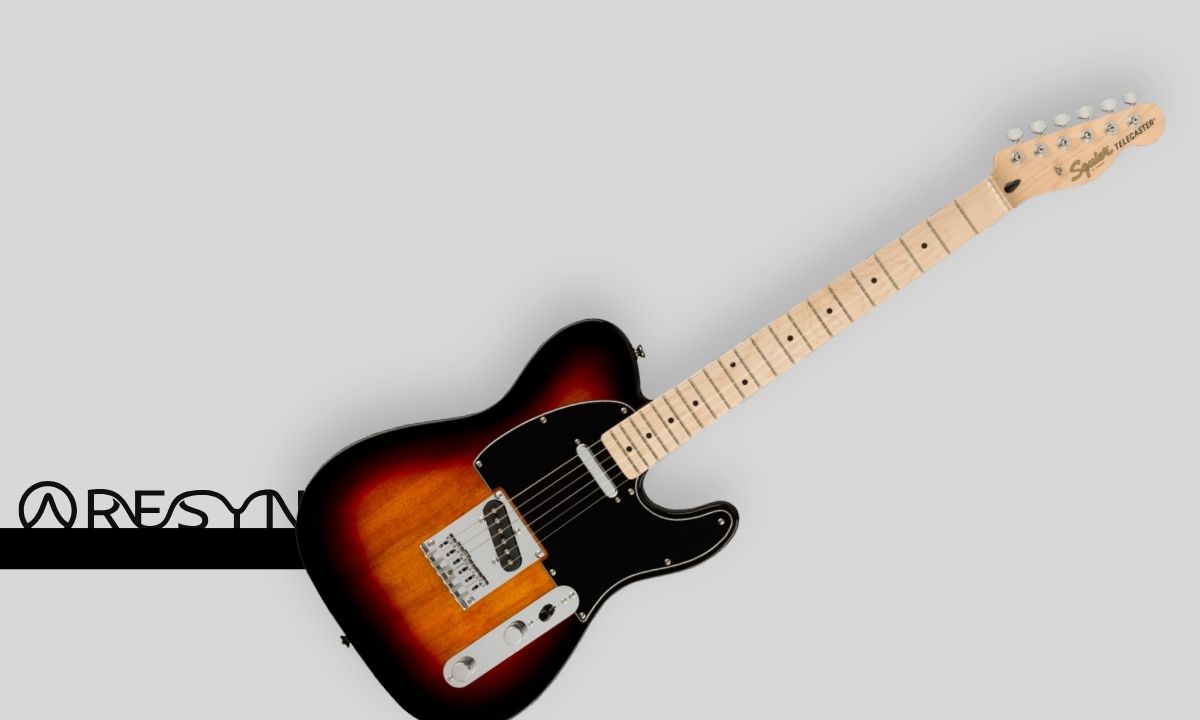
The Squier Affinity Telecaster makes a simple promise: give players the basic Telecaster formula without asking for Fender-level money.
That formula still matters. Two single-coil pickups, a 25.5-inch scale, straightforward controls, bolt-on construction, and one of the most recognizable electric-guitar shapes ever made leave very little between your hands and the amplifier.
But buying one used gets more complicated.
Affinity Telecasters have been produced across different periods, factories, specifications, finishes, and hardware configurations. Fender also expanded and revised the Affinity range significantly in 2021, while newer Thinline, Deluxe, and FMT models now sit beside the familiar two-single-coil Telecaster. A used listing that simply says “Squier Affinity Tele” doesn’t tell you enough.
The better question is not whether Affinity Telecasters are good in general.
It is whether the specific Affinity Telecaster in front of you is good for the price being asked.
Is the Squier Affinity Telecaster Good?
Yes, for the right player and the right price.
The standard Affinity Telecaster keeps the fundamental Telecaster layout intact without trying to reproduce every vintage construction detail. Fender currently builds it with a thin poplar body, maple neck, 25.5-inch scale, 9.5-inch fingerboard radius, 21 medium-jumbo frets, two ceramic single-coil pickups, a three-way selector, six-saddle string-through bridge, and sealed die-cast tuners.
That makes it especially easy to understand.
There is one volume control, one tone control, and three pickup positions. You can hear what each pickup does without navigating coil splits, active electronics, five-way switching, or complicated control layouts.
For a beginner, that simplicity has real value. For an experienced guitarist, it makes the Affinity Telecaster useful as an inexpensive backup, alternate-tuning guitar, modification platform, or straightforward instrument that does not need to be treated delicately.
Price changes the equation.
Fender currently lists the standard Affinity Telecaster at $329.99. Reverb’s used price guide, viewed in September 2026, estimates roughly $146 to $253 for used Affinity Telecasters in Good through Mint condition, based on more than 2,000 historical orders. Recent September sales shown by Reverb ranged from $200 for a Good example to around $270 for Mint examples.
That spread is where condition starts to matter more than the logo on the headstock.
A clean $200 guitar that needs nothing is one proposition. A $150 guitar needing fret work, electronics repair, and a full setup is another.
Current Squier Affinity Telecaster Specs
Here is the current standard Affinity Telecaster baseline according to Fender.
| Specification | Current Affinity Telecaster |
|---|---|
| Body | Poplar |
| Body finish | Gloss polyurethane |
| Neck | Maple |
| Neck profile | C shape |
| Construction | Bolt-on |
| Scale length | 25.5 in. / 648 mm |
| Fingerboard | Maple or Indian laurel, depending on model |
| Radius | 9.5 in. / 241 mm |
| Frets | 21 medium jumbo |
| Nut | Synthetic bone |
| Nut width | 1.650 in. / 42 mm |
| Pickups | Two ceramic single-coils |
| Controls | Master volume, master tone |
| Switching | 3-position blade |
| Bridge | 6-saddle string-through-body Tele bridge |
| Tuners | Sealed die-cast with split shafts |
| Factory strings | .009-.042 |
These specifications describe the current standard model.
They are not a universal specification sheet for every Affinity Telecaster ever sold.
What Those Specs Mean When You Play It
The 25.5-inch scale is familiar Fender territory. String tension, fret spacing, and the overall geometry feel recognizably Telecaster-like rather than scaled down for beginners.
The 9.5-inch radius is also relatively conventional for a modern Fender-family instrument. It provides a flatter playing surface than strongly curved vintage Fender boards without becoming unusually flat.
Then there is the bridge.
A six-saddle bridge gives each string its own intonation adjustment. That is useful on an affordable guitar because setup flexibility matters more than vintage correctness when you are trying to turn an inexpensive instrument into a reliable player.
The two ceramic single-coils keep the traditional bridge/neck Telecaster arrangement. Fender describes the current pickups as ceramic units, so any used listing claiming upgraded Alnico pickups, noiseless pickups, humbuckers, or boutique replacements deserves a closer inspection. It may be a legitimate modification. It simply is not stock specification for the current standard model.
Not Every Affinity Telecaster Is the Same
This is the part most used listings make unnecessarily difficult.
The Affinity name has existed long enough that two guitars wearing similar headstock logos may represent different periods of production. Fender also gave the range a notable update in 2021, adding new models while changing cosmetic and functional details across existing Affinity instruments. Contemporary reporting specifically noted revised Telecaster configurations, new fingerboard options, sealed tuners, and string-through-body bridges on that generation.
So do not use the current Fender product page to “prove” the specifications of a ten- or fifteen-year-old guitar.
Identify it first.
Ask for a clear photograph of the front and rear of the headstock, including the serial number. Compare the instrument with dated Fender documentation or reliable period catalogs where possible. Look closely at the bridge, tuners, fingerboard, pickguard, pickups, control plate, and routing before deciding what is original.
The older the guitar, the more important this becomes.
A seller can be completely honest and still describe the guitar incorrectly. “Affinity Telecaster” often becomes shorthand for any inexpensive Squier Tele-shaped instrument someone bought years ago.
Standard, Deluxe, Thinline, and FMT SH Models
The Affinity family has expanded well beyond one Telecaster.
The standard Affinity Telecaster uses the traditional solid-body shape with two ceramic single-coils and familiar master volume/master tone controls.
The Affinity Telecaster Deluxe introduced a different electronics concept with dual humbuckers rather than the traditional pair of Tele single-coils. Fender added the model during the 2021 Affinity expansion.
The newer Affinity Telecaster Thinline keeps two ceramic single-coils but changes the body architecture to a chambered poplar design with a visible F-hole. It is not simply a standard Affinity with different cosmetics.
The Affinity Telecaster FMT SH moves even farther away from the standard formula. Fender currently builds it with an okoume body, flame maple top, single-coil bridge pickup, and ceramic neck humbucker.
These distinctions matter on the used market.
A search for “Squier Affinity Telecaster” can surface guitars with different bodies, pickup layouts, electronics, and original retail positions. Compare like with like before using another listing as evidence of value.
How to Evaluate a Used Squier Affinity Telecaster
A used Affinity is inexpensive enough that buyers sometimes skip the inspection they would give a more expensive Fender.
That is backwards.
On a $2,000 guitar, a $100 repair is irritating. On a $180 guitar, the same repair changes the entire value equation.
Identify the Exact Guitar First
Start with the serial number and overall configuration.
Get clear photographs of:
- front and rear headstock
- serial number
- full front and back
- bridge
- tuners
- pickups
- control plate
- neck joint
- frets
- any visible modification
Then establish an approximate production period and compare the guitar against documentation from that period.
Look for obvious inconsistencies. New pickups, replacement tuners, drilled bridge holes, aftermarket pickguards, changed control plates, or unusual routing do not automatically make the guitar bad.
They simply change what you are buying.
A modification only adds value when the workmanship and component choice add value to you.
Check the Neck, Frets, and Nut
Spend most of your inspection time here.
Electronics are replaceable. A severely twisted neck creates a much more complicated problem.
Sight down the neck from both directions. You are looking for a reasonably consistent curve, not a ski jump, dramatic twist, or strange hump near the body joint.
Play every fret on every string if you have the guitar in hand.
Listen for choking notes, dead spots, excessive buzzing, and frets that force unusually high action. Some buzz may disappear with a normal setup. Uneven frets or structural neck problems require more work.
Check the fret ends too.
Sharp fret ends are uncomfortable, but they are not the same problem as badly uneven frets. Seasonal dryness can expose fret ends as the fingerboard shrinks slightly. A technician can usually address protruding ends without replacing the frets.
The nut deserves the same attention.
Open strings should ring cleanly. Strings should not bind badly in the slots, sit absurdly high over the first fret, or buzz because the slots have been cut too deep.
Finally, verify that the truss rod functions before buying a guitar with obvious relief problems whenever practical. Do not force it.
Check the Bridge and Tuning Hardware
A six-saddle bridge gives you useful adjustment range, but only when the hardware still works.
Look for seized saddle screws, heavy corrosion, stripped adjustment heads, missing springs, and saddles pushed to the extremes of their travel.
Then tune the guitar and use it.
Turn each tuner slowly. It should move consistently rather than slipping, grinding, or developing large dead zones.
Do not assume tuning problems automatically mean bad tuners.
Old strings, poorly wound strings, nut friction, unstable neck relief, and an incomplete setup can all create tuning complaints. Diagnose before buying replacement hardware.
Test the Electronics
Plug it into a clean amplifier.
Test the bridge pickup, middle position, and neck pickup individually. Rotate the volume and tone controls through their full range. Move the cable gently at the output jack.
You are looking for signal dropouts, severe crackling, dead switch positions, loose hardware, and obvious connection problems.
Some hum is normal for traditional single-coil pickups, especially around electrically noisy equipment. A loud buzz that changes when you touch hardware, intermittent output, or a completely dead selector position deserves investigation.
Electronics on a Telecaster are relatively straightforward.
That is good news when repairs are needed, but repairable does not mean free.
Inspect Modifications Before Treating Them as Upgrades
Used Affinity Telecasters attract modifications for an obvious reason: the entry price leaves room to experiment.
That can produce excellent guitars.
It can also produce wiring cavities full of mystery.
Common modifications include pickups, control pots, selector switches, output jacks, bridges, tuners, nuts, pickguards, and cosmetic hardware.
Ignore the seller’s upgrade cost for a moment.
Ask three different questions:
- Is the replacement part actually better for what I need?
- Was it installed cleanly?
- Did the installation permanently alter the guitar?
A $150 pickup set does not automatically add $150 to the used value.
The buyer did not select it, installation quality varies, and modified entry-level guitars often sell according to the overall instrument rather than the retail sum of their replacement parts.
Routing deserves extra attention. Enlarging pickup cavities or drilling for incompatible hardware can make future restoration or modification harder.
The Real Cost of a Cheap Affinity Telecaster
This is where the smartest used purchase happens.
Do not compare asking prices alone.
Compare usable-guitar cost.
At the time of writing, Fender lists a new standard Affinity Telecaster at $329.99. Reverb’s September 2026 price guide shows an estimated used range of roughly $146 to $253, while several recent Guitar Center examples were advertised around $170 to $210 depending on condition.
That makes a $170 guitar look immediately better than a $230 guitar.
Maybe.
Suppose the $170 example needs fret leveling, a new output jack, and professional setup work, while the $230 example has fresh strings, stable frets, smooth electronics, and correct intonation.
The cheaper guitar can become the more expensive guitar before you finish your first week with it.
Use a simple equation:
purchase price + required repairs + required setup + parts you genuinely need = real purchase cost
Keep “upgrades I want because modifying guitars is fun” in another column.
That separation matters.
A setup required to make the guitar play correctly belongs in the buying calculation. A boutique bridge pickup you want six months later does not mean the original purchase was defective.
Affinity Telecaster vs. Spending More
An Affinity makes the most sense when its limitations line up with things you either do not care about or can evaluate yourself.
A clean, well-set-up used Affinity at a meaningful discount from new pricing can be difficult to argue against for a beginner, backup instrument, alternate tuning, home-recording guitar, or modification project.
The decision gets less obvious when the price climbs.
As a used Affinity approaches the cost of other clean Squier models, compare the actual guitars rather than assuming one series name wins automatically.
Look at:
- fret condition
- nut work
- neck stability
- setup quality
- pickup configuration
- bridge hardware
- tuner condition
- weight and balance
- modification history
- included case or gig bag
- repair requirements
A higher-tier guitar with neglected fretwork can still be the worse purchase.
Likewise, an inexpensive Affinity that has been carefully set up and maintained may play far better than its position in the Squier catalog suggests.
That is why blanket statements about “cheap guitars” are not very useful once you enter the used market.
You are no longer comparing factory specifications.
You are comparing individual instruments.
Who Should Buy a Squier Affinity Telecaster?
The Affinity Telecaster makes the most sense for four types of players.
Beginners get a full-scale instrument with simple electronics and recognizable Telecaster geometry. There is very little to learn before you can focus on playing.
Budget-conscious players get an inexpensive route into a Tele-style guitar without turning every ding or rehearsal-room accident into an emotional event.
Modders get a relatively inexpensive platform with uncomplicated electronics and enormous aftermarket interest around the Telecaster format.
Experienced players buying used can sometimes find excellent value because inexpensive guitars are frequently judged by their logo before anyone checks the fretwork, setup, or actual playability.
There are also buyers who should keep looking.
If you know you want premium fretwork, a particular neck profile, vintage-correct hardware, specific pickups, or a guitar that needs absolutely nothing after purchase, buying the cheapest Affinity and replacing half of it rarely makes financial sense.
Buy closer to the instrument you actually want.
Used Affinity Telecaster Inspection Checklist
Use this before handing over the money.
- Confirm the model. Standard Affinity, Deluxe, Thinline, FMT, or another Squier Telecaster.
- Photograph the serial number. Use it with dated documentation to establish the production period.
- Check the neck for twist or severe deformation.
- Play every fret on every string.
- Inspect fret wear and fret ends.
- Check open strings for nut-related buzzing or binding.
- Verify the truss rod functions when the neck requires adjustment.
- Inspect bridge screws, saddles, springs, and adjustment range.
- Turn every tuner slowly and check for slipping or rough movement.
- Test every pickup-switch position through an amplifier.
- Rotate the volume and tone controls through their full range.
- Move the cable at the output jack and listen for dropouts.
- Identify non-original pickups, tuners, bridge parts, electronics, and routing.
- Look for cracks around the neck pocket and obvious impact damage.
- Estimate setup and repair cost before negotiating.
- Compare the total usable cost against other used examples and the current new price.
Ten minutes spent doing this can tell you more than another hour reading arguments about whether Squier guitars are “good.”
Find Used Telecasters and Electric Guitars on Resyn
Once you know what to inspect, compare the guitar itself rather than shopping by model name alone.
You can browse used electric guitars on Resyn and compare current Tele-style listings, condition, modifications, and asking prices against the checklist above.
Inventory changes, so evaluate each listing on its own merits.
The Best Affinity Telecaster Is the One You Can Identify and Inspect
The Squier Affinity Telecaster works because the basic design is simple, familiar, and useful.
That does not make every used Affinity equally good.
Current examples have a clearly documented specification, but older guitars can differ, modified examples need closer scrutiny, and a low asking price loses its appeal quickly when fretwork, setup, electronics, or hardware require immediate attention.
Identify the guitar first. Inspect the expensive problems before the cheap ones. Then calculate what it costs to make the instrument genuinely usable.
That is a better buying guide than the name on the headstock.
