

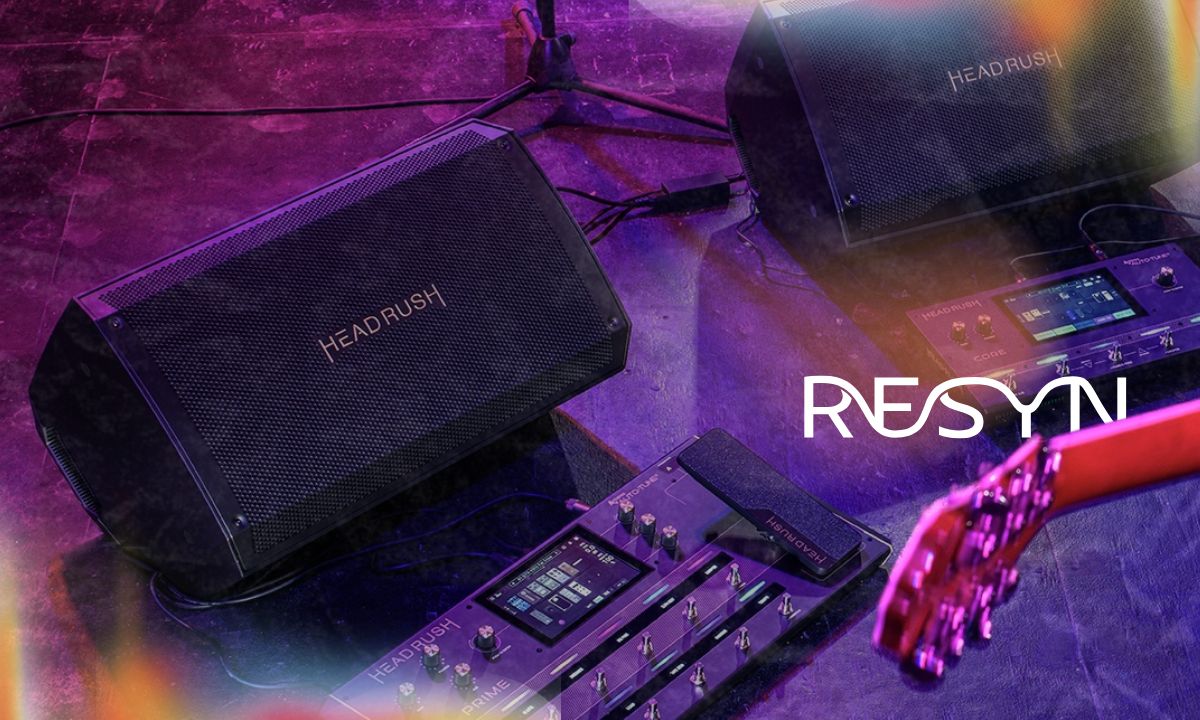
An FRFR speaker is a Full-Range, Flat-Response speaker designed to reproduce a guitar modeler’s finished sound without adding the strong tonal filtering of a traditional guitar speaker cabinet.
That definition sounds simple. The reason FRFR matters takes another minute.
A modern guitar modeler can recreate much more than an amplifier. Its signal chain can include the amp, power section, speaker cabinet, microphone, mic position, room characteristics, effects, and an impulse response (IR). Once that work happens inside the modeler, you need something at the other end that lets you hear the resulting signal without imposing another traditional guitar speaker on top of it.
That’s the job FRFR tries to do.
Line 6 describes FRFR playback as a full-range monitoring approach for modeled cabinets and IRs, while Fender and HeadRush both position their current FRFR systems specifically as powered playback for digital amp modelers and profilers.
What Does Full Range, Flat Response Actually Mean?
The name describes two separate goals: reproduce a broad range of frequencies, then reproduce them without intentionally reshaping the signal as aggressively as a conventional guitar speaker.
Neither half means “perfect.”
“Full Range” Means Reproducing More Than a Traditional Guitar Speaker
A conventional guitar speaker is part of the instrument’s tone.
It doesn’t simply make an electrical signal louder. The cone, cabinet, construction, resonance, breakup behavior, and frequency response all shape what eventually reaches your ears. That coloration is one reason swapping speakers can noticeably change an otherwise identical amplifier.
FRFR systems take a different approach. They normally use a low-frequency driver alongside a high-frequency driver or compression driver so the cabinet can reproduce substantially more of the spectrum contained in a modeled signal. Fender’s Tone Master FR-10, for example, uses a 10-inch speaker with a separate high-frequency driver, while current HeadRush FRFR cabinets use woofer and compression-driver designs.
That extended response matters because an amp modeler’s cabinet block is already creating the filtered sound of a guitar speaker, often including the effect of a virtual microphone or captured IR.
You want to hear that result.
“Flat Response” Means Less Intentional Coloration, Not Perfectly Flat
“Flat” causes more confusion than “full range.”
It does not mean every FRFR cabinet produces an absolutely identical sound at every frequency, listening position, room, or volume. Real loudspeakers interact with cabinets, floors, walls, stages, crossover systems, drivers, and your physical position in front of them.
The useful definition is simpler: an FRFR system aims to reproduce the source relatively neutrally rather than impose the deliberately limited and recognizable voice of a traditional guitar speaker.
HeadRush describes the goal as reproducing modeler output without added coloration. Line 6 makes the more practical point that your playback system still matters and that even a good FRFR cabinet won’t physically behave exactly like every guitar cabinet its modeler recreates.
That’s the distinction worth remembering.
Why FRFR Speakers Make Sense With Guitar Modelers
Think about the entire rig instead of the box sitting on the floor.
A traditional amplifier rig builds much of its final sound physically. A digital modeler can build that same chain virtually, then hand the completed signal to whatever playback system comes next.
Your Modeler Already Creates Much of the Guitar-Cab Sound
A typical modeler preset might look something like this:
Guitar → amp model → cabinet model or IR → effects → FRFR speaker
The cabinet model is important.
A modeled cabinet or IR captures characteristics associated with a speaker-and-microphone system, rather than sending the raw sound of a simulated amplifier directly to a generic loudspeaker. Line 6’s Powercab documentation illustrates this concept by separating cabinet modeling and impulse-response processing from the full-range playback system that reproduces the result.
This is why changing an IR or virtual cabinet can transform a preset even when the amp model stays exactly the same.
FRFR Lets the Modeled Cabinet Stay in the Signal
With an FRFR rig, the modeler’s cabinet or IR block normally remains active.
The speaker receives the modeled result and reproduces it.
So if your preset contains a small open-back combo cabinet for one patch and a closed-back high-gain cabinet for another, an FRFR system lets those different virtual cabinet choices remain part of what you actually hear.
Line 6 describes its Powercab Flat mode in almost exactly those terms: players who want to use the cabinet models already inside their modeler select full-range playback and hear those presets amplified through the external system.
That’s one of FRFR’s biggest advantages. One physical playback cabinet doesn’t lock every preset to one conventional guitar speaker.
A Traditional Guitar Cab Changes the Equation
Now change the chain:
Guitar → amp model → external power amp → traditional guitar cabinet
Here, the physical guitar cabinet becomes part of the tone again.
For that reason, many modeler rigs feeding conventional guitar speakers bypass the modeler’s cabinet or IR stage. Otherwise, you’re taking the sound of a modeled speaker-and-microphone combination and sending it through another heavily voiced guitar speaker.
That isn’t automatically wrong. Guitar rigs have produced great sounds through stranger combinations.
But you need to know it’s happening.
The practical difference is simple: FRFR usually reproduces the virtual cabinet. A traditional guitar cabinet becomes the cabinet.
FRFR Speaker vs Guitar Cabinet
Neither design wins automatically. They solve different problems.
| FRFR Speaker | Traditional Guitar Cabinet | |
|---|---|---|
| Primary role | Reproduce the modeled signal | Become part of the guitar tone |
| Frequency behavior | Broad, relatively neutral playback | Deliberately colored guitar-speaker response |
| Cab/IR simulation | Usually left on | Often bypassed when using the physical cab |
| Preset flexibility | High across many modeled cabinets | Every preset passes through the physical speaker |
| Stage experience | Closer to monitored/recorded modeler tone | Familiar physical guitar-cab response |
| Typical pairing | Modelers, profilers, multi-effects | Guitar amps or modeler + power amp rigs |
| Best fit | Players wanting the complete modeled chain | Players wanting a specific real cabinet character |
FRFR Prioritizes the Modeled Sound
An FRFR setup makes the most sense when your modeler is the center of the rig.
You may have a clean combo preset, a huge high-gain stack, an acoustic patch, and a completely different IR on the next footswitch. A relatively neutral playback system allows those choices to remain meaningfully different.
It also creates a closer conceptual relationship between your stage monitor and the modeled signal sent elsewhere.
Not identical. Closer.
Guitar Cabinets Prioritize Their Own Speaker Character
A traditional guitar cabinet does the opposite, and that’s exactly why players love them.
Run ten amp models through the same real 2×12 and every preset still passes through those physical speakers, that enclosure, and their dispersion pattern. The cabinet becomes a common tonal thread across the rig.
For some guitarists, that’s a limitation.
For others, that’s home.
“Amp in the Room” Is About More Than Frequency Response
This phrase causes endless arguments because people often use it to describe several different sensations.
A close-miked guitar cabinet heard through studio monitors is not the same physical experience as standing a few feet from that cabinet. A 1×12 doesn’t move air around you like a 4×12. Driver placement, enclosure dimensions, dispersion, room reflections, volume, and listening position all influence what you perceive.
Line 6 makes this distinction directly in its discussion of modeler playback systems: even an accurate FRFR system cannot make one physical cabinet configuration behave exactly like another physical cabinet configuration.
So FRFR accuracy and traditional cabinet feel aren’t mutually exclusive ideas.
They’re different questions.
Is an FRFR Speaker the Same as a PA Speaker?
Sometimes they’re closer cousins than the marketing makes them sound.
Both categories often use broad-band loudspeaker designs with low-frequency and high-frequency drivers, built-in amplification on powered models, line-level inputs, and enough output for rehearsal or stage monitoring.
But FRFR is better understood as a design goal and guitar-modeler use case than a guarantee that every cabinet bearing the label shares one unique circuit architecture.
A guitar-focused FRFR enclosure may add cabinet styling, guitar-oriented EQ controls, modeler-friendly connectivity, floor-monitor positioning, or voicing intended specifically for amp and cabinet emulations. Fender’s Tone Master FR-10, for example, combines a two-way powered system with guitar-oriented stage EQ and traditional backline styling. HeadRush offers similar modeler-specific cabinet formats with woofer/compression-driver systems and stage-oriented connections.
A good powered PA speaker can also reproduce a modeler effectively.
The useful comparison is therefore not the logo printed on the grille. Look at the individual speaker’s response, dispersion, controls, inputs, output capability, form factor, and how it behaves with your rig.
FRFR vs Studio Monitors
Studio monitors and FRFR guitar systems share a basic philosophy: reproduce the source without the unmistakable filtering of a traditional guitar cabinet.
Their jobs are still different.
Studio monitors usually live close to the listener in a controlled recording or mixing position. Stage-oriented FRFR cabinets need to project into rehearsal rooms, venues, floors, risers, and spaces where you aren’t sitting at a desk three feet away.
That changes cabinet construction, output requirements, positioning, durability, and connectivity.
For home practice, studio monitors may already give a modeler user exactly what they need. On stage, an FRFR cabinet or suitable powered monitor becomes far more practical.
Do You Need an FRFR Speaker?
No. A modeler doesn’t automatically require one.
FRFR is one playback choice among several, and the right answer depends on which parts of the modeled signal you actually want to hear.
FRFR Fits Players Who Want Their Modeler’s Complete Cab Sound
FRFR makes a lot of sense when you build presets around different cabinet models or IRs.
It’s especially useful for players who:
- switch between very different amp-and-cab combinations
- send modeled tones directly to front of house
- want a dedicated personal stage monitor
- rehearse with the same core presets used live
- depend on cabinet IRs as a major part of their sound
- use modelers for guitar, acoustic instruments, backing tracks, or other wide-band sources
Current Fender, HeadRush, and Line 6 FRFR products are all explicitly positioned around this modeler-first type of workflow.
A Traditional Guitar Cab Still Makes Sense for Some Players
FRFR isn’t an upgrade path everyone eventually needs to follow.
If you’ve spent years building your sound around one favorite cabinet and speaker combination, you may want that physical cabinet to remain part of every patch.
A modeler feeding a suitable power amp and real guitar cabinet gives you that option.
You’ll lose some of the dramatic cabinet-to-cabinet variation available inside the modeler because every preset eventually reaches the same physical speakers. In return, you retain the response and stage interaction you already know.
That’s a reasonable trade.
Home Players Have More Than One Good Option
At home, the decision gets easier.
Headphones give you silent practice. Studio monitors work well for nearfield listening and recording setups. A smaller FRFR system gives you a more portable cabinet-style rig that can move from a room to rehearsal.
Pick around the way you actually play.
Don’t buy stage-volume hardware because a modeler forum convinced you that FRFR is mandatory.
Common FRFR Setup Mistakes
FRFR rigs become confusing when the signal chain disappears behind the acronym.
Turning off the cab or IR block by accident. If the FRFR speaker is reproducing a raw amp-model signal with no cabinet stage, the result can sound harsh or unnatural because the expected guitar-speaker filtering is missing.
Running a modeled cab through a real guitar cabinet without realizing it. This stacks the virtual cabinet response with another physical guitar-speaker response. It can work creatively, but it isn’t the neutral comparison many players think they’re making.
Assuming every FRFR speaker sounds identical. They don’t. Driver design, cabinet construction, crossover behavior, dispersion, room placement, EQ, and listening position still matter. Line 6 specifically warns that the playback system remains a major part of what reaches the player.
Judging presets at wildly different volume levels. A bedroom preset and a loud rehearsal preset can feel radically different even through the same hardware. Build and compare sounds at levels relevant to how you’ll use them.
Shopping by wattage alone. Wattage tells you something about an amplifier design, but it doesn’t give you the entire real-world loudness picture. Speaker sensitivity, limiter behavior, cabinet design, maximum SPL, placement, and the type of power rating all matter.
Expecting FRFR to transform physically into every cabinet you’ve modeled. It can reproduce the spectral character encoded in those models surprisingly well. It cannot become a different-sized wooden box with different speakers simply because you selected one on a screen.
FRFR Terms Worth Knowing Before You Shop
Active / powered: The amplifier is built into the speaker enclosure. Many current guitar-focused FRFR products use this architecture. Fender’s FR-10 and current HeadRush FRFR cabinets are examples.
Passive: The cabinet requires an external power amplifier.
SPL: Sound pressure level. In practical shopping terms, maximum SPL figures give you another piece of information about potential output rather than relying on wattage alone.
Frequency response: A description of how a speaker reproduces different frequencies across its operating range.
Dispersion: How sound spreads horizontally and vertically from the speaker. This affects what you hear as you move around a room or stage.
HF driver: The high-frequency driver, often a compression driver or tweeter, that helps an FRFR design reproduce frequencies beyond the useful range of a conventional guitar speaker.
Monitor / wedge: A cabinet shape or placement designed to aim sound toward a performer from the floor.
Cabinet-style FRFR: Full-range playback packaged more like a traditional guitar cabinet. Fender’s Tone Master FR series, Line 6 Powercab, and current HeadRush FRFR CAB products show different versions of this idea.
FRFR Works Best When the Modeler Supplies the Character
The easiest way to understand FRFR is to stop thinking of it as a special kind of guitar amp.
It’s a playback system.
Your modeler builds the amplifier tone, cabinet response, microphone perspective, IR, and effects. The FRFR speaker’s job is to reproduce that finished signal broadly and relatively neutrally, giving those digital cabinet choices room to remain audible instead of replacing them with one traditional guitar speaker.
A real guitar cabinet takes the opposite approach. It adds its own recognizable voice, feel, dispersion, and physical behavior to every sound you send through it.
Neither method is inherently better.
Choose FRFR when you want the modeler to supply most of the character. Choose a traditional cabinet when you want the cabinet itself to stay part of the instrument.
For modeler-focused gear, you can also browse modeling amps on Resyn or explore powered speakers.
