

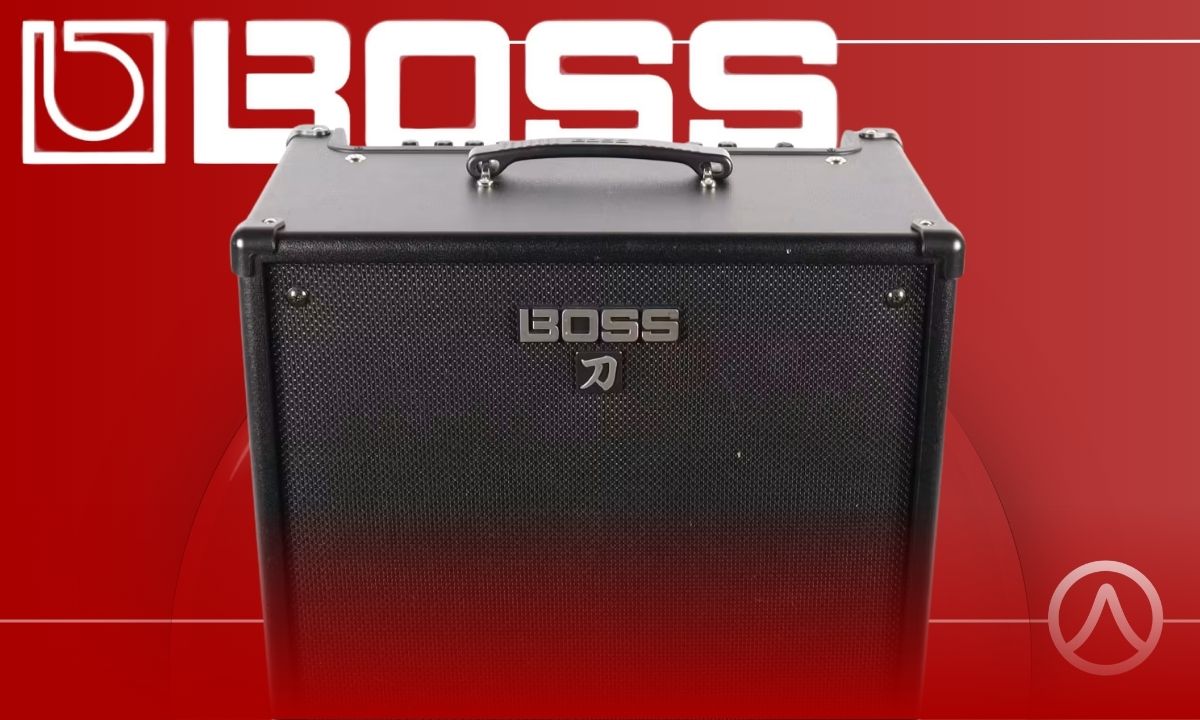
Buying a Boss Katana used to be simple. Pick the 50 if you wanted something compact, or step up to the 100 if you needed more power and connectivity.
That changed.
The Katana family now spans three major generations, several combo sizes, amplifier heads, premium Artist versions, and enough overlapping model names to make a used listing surprisingly difficult to decode. A Katana-50 MkII and Katana-50 Gen 3 look like close relatives because they are, but the differences matter once software, connectivity, foot control, and price enter the picture.
The useful question isn’t simply, “Which Boss Katana is best?”
It’s which Katana gives you the features your rig actually needs without making you pay for the ones it doesn’t.
The Boss Katana Family in 60 Seconds
Boss introduced the Katana series in 2016. The MkII generation followed in 2019, and Boss launched Katana Gen 3 in 2024. The current Gen 3 guitar-amplifier family includes the Katana-50, 50 EX, 100, 100/212, Head, Artist, and Artist Head.
The family makes more sense if you separate generation from model.
| Model type | Basic role | What changes as you move up |
|---|---|---|
| Katana-50 | Compact 1×12 combo | Lowest weight and simplest control/connectivity |
| Katana-50 EX | Expanded 50-watt combo | Better external control and connectivity |
| Katana-100 | 100-watt 1×12 | Effects loop, deeper stage control, more I/O |
| Katana-100/212 | 100-watt 2×12 | Larger speaker system and cabinet |
| Katana Head | 100-watt amplifier head | External cabinet flexibility |
| Katana Artist | Premium 100-watt combo | Waza speaker and expanded tone/control hardware |
| Katana Artist Head | Premium amplifier head | Artist feature set for external cabinets |
Then there are the generations.
A used Katana-50 might be an original model, a MkII, or a Gen 3. Those aren’t cosmetic revisions. The control architecture, available amp characters, software ecosystem, connections, and stage features changed as the platform evolved.
That’s why identifying the full model name matters before discussing price.
Boss Katana Generations: Original vs MkII vs Gen 3
The Katana generations share the same underlying idea: an affordable solid-state guitar amplifier built around Boss’s Tube Logic architecture, onboard effects, preset storage, power control, and software editing.
What changed is how much control Boss wrapped around that core.
Original Katana / Gen 1
The first Katana generation established the formula in 2016.
The original Katana-100, for example, offered five amplifier types, four channel memories plus the panel state, a send/return effects loop, line output, GA-FC support, USB connectivity, and selectable power settings down to 0.5 watts.
That last detail matters when you’re shopping used.
A first-generation Katana isn’t automatically obsolete because two newer generations exist. Boss still provides firmware, Tone Studio software, drivers, and manuals for original Katana hardware through its support system.
But age changes the buying equation. You’re dealing with older hardware, the original software platform, fewer amp/effect options than later generations, and model-specific limitations that need to be weighed against the asking price.
Cheap enough, that can make sense.
Close to MkII money, it gets harder to justify.
Katana MkII
MkII is where the used Katana market gets interesting.
The Katana-50 MkII kept the familiar 50-watt 1×12 format but added a Variation function across its five core amp types and separated the effects architecture into Booster, Mod, FX, Delay, and Reverb sections. It also gained Power Amp In for external modelers and multi-effects units.
Boss still supports MkII with current Tone Studio downloads, system software, drivers, manuals, and documentation.
That continued support is a big reason MkII deserves serious attention secondhand.
You’re buying a discontinued generation, but not an abandoned one.
The model hierarchy also matters. The Katana-50 MkII gives you four Tone Setting memories, a 12-inch speaker, USB-B connectivity, Power Amp In, and power scaling between 0.5, 25, and 50 watts. It does not provide the effects loop or GA-FC support found farther up the range.
Move to a Katana-100 MkII or Head MkII and the rig becomes much more stage-oriented. You gain the send/return loop, line output, GA-FC compatibility, and broader external-control options. The MkII Head also includes MIDI input and a dedicated speaker output.
That’s a bigger difference than the wattage badge suggests.
Katana Gen 3
Gen 3 arrived in 2024 and refined the Katana platform rather than throwing it away.
Boss retained the existing Clean, Crunch, Lead, Brown, and Acoustic characters while introducing the Pushed amp character. The current Katana-50 Gen 3 provides six amp characters with variations, five independent effects sections, four Tone Setting memories, USB-C recording, Power Amp In, optional Bluetooth connectivity through Boss’s BT-DUAL adapter, and a redesigned Tone Studio environment.
The larger Gen 3 models add considerably more.
The Katana-100 Gen 3 has eight Tone Setting memories, a send/return effects loop, line output, Stereo Expand, GA-FC and GA-FC EX compatibility, expression-pedal support, USB-C, and the optional BT-DUAL Bluetooth adapter slot.
The Head and Artist tiers expand things again. The Gen 3 Head adds Bloom, MIDI input, a speaker output, and an onboard 5-inch practice speaker. The Artist Gen 3 uses a custom 12-inch Waza speaker and adds Bloom, multiple speaker outputs, MIDI input, XLR and 1/4-inch line outputs, and deeper front-panel control.
Gen 3 is the most complete Katana platform.
That does not automatically make it the smartest used purchase.
Which generation makes sense used?
Start by separating features you need from features you simply like knowing are there.
A home player who uses the amp’s internal effects may get nearly everything they need from a clean Katana-50 MkII. That buyer gains very little from paying extra for an effects loop they’ll never connect, MIDI they’ll never program, or stage-control hardware they’ll never put on the floor.
A player building a pedalboard has a different problem.
Once delays, reverbs, loopers, external preamps, or complex foot control enter the rig, the 100-watt models and higher tiers become much easier to justify. The effects loop and GA-FC ecosystem change how the amplifier integrates with the rest of the setup.
Used value lives in that gap.
The cheapest Katana isn’t always the better deal. The one that prevents you from replacing it six months later often is.
Boss Katana Models Compared
The current Gen 3 line looks crowded until you stop thinking about it as seven different amplifiers.
It’s really a ladder of increasing control, connectivity, cabinet size, and stage capability.
Katana-50
The Katana-50 Gen 3 is the straightforward entry point.
You get 50 watts, one 12-inch speaker, six amp characters with variations, four Tone Setting memories, five onboard effects sections, Power Amp In, headphone output, USB-C recording, power control, and optional Bluetooth through the BT-DUAL adapter.
It weighs 25 pounds 10 ounces, which matters more than people give it credit for. A practice amp becomes a rehearsal amp much faster when carrying it through a doorway doesn’t become a negotiation.
The compromises are equally concrete.
There’s no send/return effects loop. There’s no GA-FC support. Boss also excludes the basic Katana-50 from the Stereo Expand functionality supported across most of the larger Gen 3 and MkII models.
For a self-contained amp, that’s fine.
For a growing pedalboard, it can become the reason you eventually move up.
Katana-50 EX
The 50 EX exists for the player who likes the physical size and output of the 50 but needs stronger external control.
Boss gives the 50 EX Stereo Expand, line output, and support for the GA-FC and GA-FC EX foot controllers while retaining the compact 50-watt 1×12 format.
That makes the EX easy to overlook and easy to understand.
You aren’t mainly paying for more volume. You’re paying to remove some of the control limitations of the standard 50.
For a player using patches live, that matters.
For a bedroom player who sets one sound and reaches down to change effects manually, it probably doesn’t.
Katana-100
The Katana-100 is where the family turns into a much more complete stage amplifier.
It is still a 1×12 combo, but Boss adds a send/return effects loop, line output, Stereo Expand, GA-FC and GA-FC EX compatibility, eight Tone Setting memories, and more extensive external control.
That changes what the amplifier can do with a real rig.
Want time-based pedals after the Katana’s preamp? The effects loop solves that.
Want to change full amp/effect configurations from the floor? The GA-FC ecosystem becomes useful.
Want a dedicated feed to a PA while keeping the combo on stage? You have a line output.
The 100 also weighs 32 pounds 11 ounces versus the Gen 3 50’s 25 pounds 10 ounces. That isn’t enormous, but it is enough to become noticeable after the third flight of stairs.
Katana-100/212
The 100/212 keeps the same 100-watt output but swaps the single 12-inch speaker for two custom 12-inch speakers.
That pushes the cabinet to 43 pounds 11 ounces.
Buy it because you specifically want a 2×12.
Don’t buy it because “two speakers must be twice as good.”
A larger cabinet changes spread, physical feel, stage footprint, transportation, and how much air the rig moves around you. Those benefits are real for the right player. They’re also the exact reasons someone loading into bars, rehearsals, and upstairs studios may prefer the smaller 1×12.
Katana Head
The Katana Head makes sense when the cabinet is part of your rig rather than part of your amplifier.
The current Gen 3 Head delivers 100 watts into an external cabinet, includes a speaker output rated for a minimum 8-ohm load, and still has an onboard 5-inch speaker for practice and checking sounds without connecting a larger cabinet.
It also includes Bloom, MIDI input, an effects loop, line output, GA-FC support, USB-C, and Power Amp In.
That’s an unusually useful combination.
You can treat it like a compact home amp one evening, plug it into a proper guitar cabinet the next, then integrate it into a more complex MIDI-controlled rig later.
Of course, that flexibility only saves money if you already own or actually want an external cabinet.
Katana Artist and Artist Head
The Artist models aren’t simply Katanas with nicer badges.
The Artist Gen 3 combo uses Boss’s custom 12-inch Waza speaker and adds Bloom, deeper panel control, MIDI input, expanded line-output options, and multiple speaker outputs for external cabinets.
That positions the Artist differently from the basic 50-versus-100 question.
You’re no longer deciding how much Katana functionality you need. You’re deciding whether you want the premium speaker, cabinet, routing, and control package that sits at the top of the platform.
For a new player buying a first serious amplifier, that can be overkill.
For someone already committed to Katana as the center of a live rig, the Artist makes much more sense.
Boss Katana 50 vs 100: The Differences That Actually Matter
The Katana-50 versus Katana-100 comparison gets flattened into wattage far too often.
The wattage matters.
The connectivity matters more.
Both current models use a single 12-inch speaker and both provide power control for lower-volume playing. The 50 isn’t simply a “bedroom amp,” and the 100 isn’t automatically too loud to use at home because its maximum rating says 100 watts. Boss gives both designs reduced-output operation.
The real dividing line is your rig.
The standard Gen 3 Katana-50 gives you four Tone Setting memories, basic footswitch/expression control, Power Amp In, headphones, and USB-C. The Katana-100 doubles the stored Tone Setting capacity to eight and adds the effects loop, line output, Stereo Expand, and GA-FC/GA-FC EX support.
That’s why the 100 often makes more sense for gigging even when you don’t need twice the rated output.
It removes friction.
A delay pedal can sit after the preamp. Multiple live sounds can be recalled from the floor. The amp can feed a PA. A more complex rig has somewhere to grow.
The 50 wins on simplicity, portability, and cost.
Neither one wins universally.
Choose around your rig, not the wattage number
For home practice, the standard 50 is usually the cleanest place to start.
For rehearsals, either can work depending on the drummer, genre, stage volume, and whether the amp stays clean enough at the level you need.
For regular gigging, the 100’s routing and foot-control advantages become far more valuable.
For a pedalboard centered around drives in front of the amp, a 50 may still be enough.
For a pedalboard where delays, reverbs, or loopers need an effects loop, the decision changes immediately.
Look at the back panel before the wattage sticker.
Is a Used Boss Katana Worth Buying?
Yes, if the price reflects the exact generation, model, condition, and included accessories.
That’s the important part.
Katana has been popular for long enough that the used market contains original models, MkII units, Gen 3 amplifiers, retailer open-box stock, footswitch bundles, and local-pickup deals all appearing beside one another.
A search result showing a Katana for “$200” tells you almost nothing until you know which one it is.
How we evaluate used Katana value
Use four variables.
First: exact generation.
A Katana-50, Katana-50 MkII, and Katana-50 Gen 3 are different products.
Second: included hardware.
A GA-FC or GA-FC EX has real value on compatible models. So do covers, Bluetooth adapters, original packaging, and other accessories you planned to buy anyway.
Third: condition and shipping.
A heavy combo sold locally and a clean example shipped across the country do not belong in the same effective-price comparison.
Fourth: compare asking prices with actual sold evidence whenever possible.
Asking prices tell you what sellers want.
Completed transactions tell you what buyers accepted.
Current marketplace observations show exactly why broad price guides get messy. A Gen 3 Katana-50 open-box listing recently appeared at $299.99 against a stated typical new price of $349.99, while used MkII listings vary widely with condition, geography, shipping, and seller type. A current used Katana-100 MkII listing, for example, was advertised around $360, while another documented sale of a very-good example closed at $269 before shipping.
Those figures aren’t a permanent price guide.
They’re evidence of why you need to compare like with like.
When an older MkII makes more sense than Gen 3
MkII is attractive when the price gap is meaningful and you don’t need Gen 3-specific improvements.
The Katana-50 MkII already gives you the core Katana experience: five amp characters with variations, five separate effects categories, four Tone Setting memories, Power Amp In, USB recording, and power scaling down to 0.5 watts.
Boss still provides current MkII support software.
If you find a clean one at a substantially lower effective price than Gen 3, there isn’t much reason to reject it simply because a newer badge exists.
The same logic applies to the 100.
A clean Katana-100 MkII still gives you the effects loop, line output, GA-FC support, Stereo Expand, and the broader stage connectivity that separates the 100 from the standard 50.
That’s a lot of amplifier for someone who doesn’t care about the newer Pushed character, USB-C, optional Bluetooth workflow, or other Gen 3 refinements.
When paying for Gen 3 makes more sense
The smaller the used-price gap becomes, the stronger Gen 3 looks.
You get newer hardware, the current software platform, USB-C, the Pushed amp character, optional BT-DUAL integration, and generation-specific feature improvements.
You also remove some uncertainty.
A new or open-box amp gives you newer components, clearer return options from many retailers, and less chance that years of rehearsal rooms, vans, dust, beer, and questionable extension cords have already become part of its history.
That has value.
A bargain MkII can beat Gen 3 on price.
A MkII priced only slightly below a comparable Gen 3 needs a much better reason.
What to Check Before Buying a Used Boss Katana
Digital modeling amps remove some of the inspection drama associated with old tube amplifiers.
They don’t remove the need to test things.
A Katana still has a speaker, jacks, pots, switches, power electronics, USB connectivity, memory functions, and years of possible physical wear.
Check all of it.
Test the speaker and amplifier section
Start with a simple clean sound.
Listen at low volume first, then increase it gradually. You’re listening for cabinet rattles, speaker distortion that doesn’t belong there, intermittent output, crackling, buzzing, or anything that changes when the cabinet vibrates.
Don’t test a used amp only with a heavily distorted preset.
Gain hides problems.
Use the power-control positions as well. Make sure the amplifier behaves normally when moving between reduced-output and full-power settings.
If you’re buying locally, give the amp enough time to operate at a useful volume. A five-second demonstration in someone’s driveway proves very little.
Test the controls and connections
Turn every control.
Press every button.
Plug into the headphone output.
Test USB if computer recording matters to you.
On a 100, Head, or Artist model, test the send and return jacks if possible. Test the line output if it’s part of your planned live setup. If a GA-FC is included, connect it and confirm that the amplifier responds correctly.
Gently moving an inserted cable can expose a worn or damaged jack.
You’re not trying to abuse anything. You’re checking for intermittent connections before they become your problem.
Check software, firmware, and included accessories
Software matters more on a Katana than it does on a traditional one-channel combo.
Confirm the exact generation first, then download the correct Boss support software for that generation. Original Katana, MkII, and Gen 3 each have their own support path and Tone Studio environment. Boss currently maintains downloadable support resources for all three.
Don’t assume a Bluetooth adapter is built into a Gen 3 amp because the seller says “Bluetooth compatible.”
On the current models, Boss lists the BT-DUAL Bluetooth Audio MIDI Dual Adaptor as an optional accessory rather than standard hardware.
The same rule applies to foot controllers.
A GA-FC sitting beside an amplifier in a photo doesn’t mean it’s included. Ask.
Which Boss Katana Fits Your Situation?
The model chart gets easier once you start with the job.
Home and apartment practice
Start with the Katana-50.
It is compact, comparatively light, scales down to 0.5 watts, has headphone output, includes the main Katana sound/effects system, and doesn’t force you to pay for stage-routing features you may never touch.
A used 50 MkII becomes especially attractive when the discount from Gen 3 is substantial.
Don’t assume 100 watts automatically makes the 100 unusable at home, though. Its power control also reaches 0.5 watts.
The difference is that you’re carrying and paying for capabilities beyond practice.
Rehearsals and first gigs
This is where the 50-versus-100 choice becomes personal.
A Katana-50 has enough rated output to enter real rehearsal and performance territory, but volume requirements depend heavily on the band, drummer, room, clean-headroom needs, and whether the amp is reinforced through a PA.
If you already know you’ll need more sophisticated foot control or an effects loop, skip the debate.
Look at the 50 EX or 100.
Regular gigging and pedalboards
The Katana-100 is the practical center of the range.
You get the compact 1×12 format without giving up the effects loop, line output, GA-FC compatibility, Stereo Expand, or expanded Tone Setting memory.
That doesn’t make it the most glamorous Katana.
It makes it difficult to outgrow.
Recording and direct workflows
Every modern Katana generation supports some form of USB recording, but Gen 3 moves the current platform to USB-C and provides IR-based cabinet sound on its direct outputs.
For simple home recording, the 50 handles the job.
If the amplifier needs to double as a stage rig with a dedicated line output, the 100 becomes more flexible.
Players who already own speaker cabinets
Buy the Head because you actually want a head.
That sounds obvious, but it’s easy to get distracted by feature sheets.
The Gen 3 Head makes unusual sense as a hybrid because the built-in 5-inch speaker lets you practice without connecting a full cabinet, while the rear speaker output turns it into a normal 100-watt head when you need one.
If you already own a cabinet you like, that’s useful.
If you don’t, price the cabinet before convincing yourself the head is cheaper.
Buyers prioritizing premium cabinet and speaker performance
That’s where the Artist belongs.
The custom Waza speaker, expanded output options, Bloom function, MIDI capability, and deeper control system distinguish it from the normal Katana-100.
Buy those differences intentionally.
If what you really want is Katana effects, presets, and a loud 1×12, the regular 100 already covers an enormous amount of ground.
What About Katana Mini, Katana-Air, Katana Bass, and Katana:GO?
Boss uses the Katana name across products that don’t belong in a straight 50-versus-100 guitar-combo comparison.
That includes smaller practice products, wireless desktop formats, headphone-oriented products, and dedicated bass amplifiers.
Treat them as separate branches of the family.
A Katana Mini buyer is solving a portability problem.
A Katana:GO buyer is solving a personal-practice/headphone problem.
A Katana Bass buyer needs an amplifier voiced and equipped for bass.
They share the Katana name and some design philosophy, but putting all of them into one comparison table makes the buying decision less useful, not more.
Alternatives to Consider Before Buying a Katana
The best alternative depends on what you dislike about Katana.
If the software depth feels excessive, look for an amplifier that exposes more of its personality directly through the front panel.
If you already own a sophisticated modeler, ask whether you need another modeling preamp at all. A dedicated power amp, powered cabinet, or FRFR system may fit the signal chain more naturally.
If you want one strong traditional amplifier voice instead of dozens of configurable sounds, a simpler solid-state or tube combo may make you happier every time you turn it on.
And if portability dominates everything else, desktop amps and compact personal systems deserve attention before a 1×12 combo.
Katana’s strength is breadth.
That’s also the clue that it won’t suit every player.
The Right Katana Is the One Whose Features Match Your Rig
Don’t choose a Boss Katana by chasing the largest wattage number or the newest generation.
Start with the connections.
Decide whether you need an effects loop, serious foot control, line output, external speaker capability, MIDI, or a premium speaker. Then look at the generations that provide those things and compare real used prices against current Gen 3 alternatives.
For a simple home rig, a Katana-50 or clean 50 MkII may be all the amplifier you need.
For a pedalboard and regular gigs, the 100 earns its extra size through routing and control rather than raw volume alone.
And on the used market, generation matters less than value. A well-priced MkII with the right connections can be a better purchase than a newer amplifier packed with features that never leave the back panel.
