

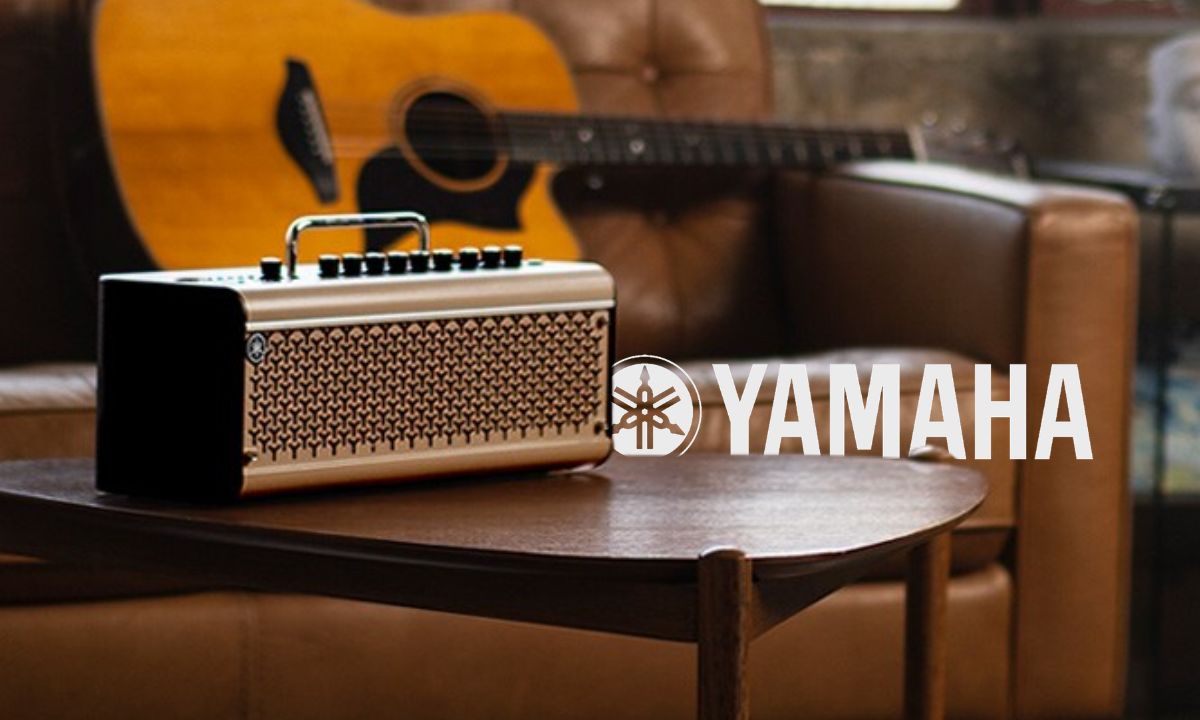
The Yamaha THR30II Wireless makes the most sense when you stop treating it like a shrunken stage amp.
It is a compact stereo modeling system built for the places where a full-size combo often becomes awkward: home practice, late-night playing, desktop recording, backing-track work, portable sessions, and rooms where turning up a traditional guitar amp simply is not practical.
That distinction matters. Yamaha rates the THR30II Wireless at 30 watts on external power, but its two 3.5-inch full-range speakers, stereo architecture, rechargeable battery, USB audio interface, Bluetooth connection, built-in wireless receiver, and THR Remote editor all point toward a different kind of ownership experience than a normal 1×10 or 1×12 combo.
It is also why the THR30II remains interesting on the used market. You are not only buying an amplifier. You are buying a battery-powered modeling platform with software, wireless hardware, multiple I/O paths, memories, speakers, and several systems that deserve individual testing before money changes hands.
This review is based on Yamaha’s current documentation and published expert reviews. Resyn is not claiming hands-on testing of this specific unit.
Yamaha THR30II at a Glance
The THR30II Wireless sits at the top of Yamaha’s standard THR-II guitar range. It gives you 15 guitar amp models, three acoustic models, three bass models, three flat voicings, onboard modulation and ambience effects, five user memories, Bluetooth Audio/MIDI, USB audio, stereo line outputs, a rechargeable battery, and an integrated guitar-wireless receiver.
Its basic specification tells you a lot about the intended buyer.
| Feature | Yamaha THR30II Wireless |
|---|---|
| Guitar amp models | 15 |
| Acoustic models | 3 |
| Bass models | 3 |
| Flat voicings | 3 |
| Speakers | 2 x 3.5-inch full-range |
| Rated output | 30W on AC power |
| Battery output | 15W |
| Battery | Built-in rechargeable |
| Approx. battery life | 5 hours, depending on use |
| Guitar wireless receiver | Built in |
| Bluetooth | Audio/MIDI |
| USB | USB Audio Class 2.0 |
| Line outputs | Stereo 1/4-inch L/R |
| User memories | 5 |
| Weight | 4.3 kg / 9.5 lb |
Those specifications make the THR30II easy to misunderstand if you judge it by amplifier wattage alone.
This is primarily a home, desktop and portable amp that also happens to offer useful recording and performance connectivity. Yamaha itself describes the THR concept as a “third amp” designed around home playing rather than simply shrinking a conventional stage amplifier.
That framing fits the product better.
What the THR30II Actually Sounds and Feels Like to Play
The strongest consensus among established THR30II reviews is that Yamaha got the low-volume experience right.
Guitar World praised the sounds, straightforward top-panel controls, wireless features and extra headroom, while MusicRadar described the THR30II as a strong home amp for practice and recording. Both reviews also noted its relatively high cost compared with simpler alternatives.
That low-volume focus is important because many guitar amps become less satisfying precisely where home players use them most.
A traditional amp can lose some of its physical impact when the volume is reduced enough for apartment or late-night use. The THR30II approaches the problem differently. Its small full-range speakers, stereo processing and modeling architecture are designed around controlled playback rather than moving air like a conventional guitar cabinet.
Do not read that as “sounds exactly like a large tube amp in the room.”
It does not.
The more useful question is whether the THR30II produces an enjoyable, responsive guitar sound at volumes where a larger rig becomes inconvenient. Published reviews have consistently treated that as one of its strengths. Guitar World specifically highlighted the broad tonal range and easy access to the onboard models, while MusicRadar praised its combination of sounds, controls and wireless functionality.
The stereo presentation also changes the experience.
Delay, reverb, backing tracks and music playback can spread across two speakers instead of collapsing into a single small driver. That does not make the cabinet physically larger, but it helps explain why the THR can feel more like a compact personal sound system than a miniature practice combo.
For home players, that is the point.
Amp Models, Effects and THR Remote
The THR30II gives you enough physical control to use it without immediately reaching for a phone or computer.
That is one of its better design decisions.
Classic, Boutique and Modern Modes
The core electric-guitar section revolves around five familiar amp categories: Clean, Crunch, Lead, Hi Gain and Special.
Each can operate in Classic, Boutique or Modern mode, giving the THR30II 15 guitar amp models. Yamaha also provides bass, acoustic and flat options for instruments or sources that do not fit the normal electric-guitar signal chain.
The important difference is not simply the number 15.
On the THR30II, the model variations are available from the hardware. The THR10II family can access the broader model set through THR Remote, while the THR30II gives you more direct physical access from the top panel. Yamaha’s current comparison chart documents that distinction, and Guitar World identified it as one of the THR30II’s practical usability advantages.
That matters if you dislike editing basic guitar tones through an app.
You can treat the THR30II like an amp first.
Effects You Can Control From the Amp
The onboard effects cover chorus, flanger, phaser and tremolo, with echo, echo/reverb, spring reverb and hall reverb available in the ambience section.
A compressor and noise gate are available through the editor application.
The physical interface remains intentionally simple. Pick the amp character, adjust gain and master behavior, shape bass, middle and treble, add effects, then balance guitar level against playback audio.
Five memory buttons let you save sounds you want to recall later.
It is not a replacement for a large programmable floor modeler. That is a feature, not automatically a limitation.
What THR Remote Adds
THR Remote opens the deeper layer.
Yamaha currently offers THR Remote 1.6.0 for Mac and Windows, last updated December 17, 2025, with the firmware update process included through the installer. Yamaha also maintains its Windows ASIO driver and current THR-II documentation.
That ongoing support matters for a used amp.
The THR30II is old enough that a secondhand buyer needs to think beyond whether sound comes out of the speakers. A healthy used unit should also communicate correctly with the current software environment you intend to use.
The app is useful for deeper editing, preset management and functions such as compressor and noise gate. But you do not need the editor open every time you want to play.
That balance is one of the THR30II’s better qualities.
Wireless, Bluetooth and Recording Are Three Different Things
The word “wireless” causes unnecessary confusion around the THR30II because the amplifier contains several unrelated connection systems.
They do different jobs.
Guitar Wireless
The THR30II Wireless contains a compatible guitar-wireless receiver.
It does not mean every THR30II sale includes a guitar transmitter.
Yamaha currently lists the YW10T plus Line 6 G10T and G10TII transmitters as compatible options, and explicitly describes the transmitter as sold separately.
That distinction becomes important on the used market.
A seller may describe a THR30II as “wireless” even when no transmitter is included. Nothing is necessarily missing from the amplifier itself. The receiver is built into the THR30II; the transmitter is the separate piece that plugs into the guitar.
If a transmitter is part of the deal, test it.
Do not assign extra value to a wireless bundle until you know both pieces communicate and charge correctly.
Bluetooth
Bluetooth handles another job.
Yamaha supports Bluetooth audio playback and MIDI communication on the THR-II platform. It is useful for playing backing tracks, music or other audio through the amplifier, and it participates in the broader remote-control workflow.
Bluetooth does not replace the dedicated guitar-wireless system.
Think of them as separate paths:
Guitar wireless: instrument to amp.
Bluetooth: playback and compatible control/data functions.
Keeping those paths separate makes troubleshooting much easier.
USB Recording and Stereo Line Outputs
USB turns the THR30II into more than a practice amp.
Yamaha specifies USB Audio Class 2.0 connectivity for recording and playback, and the company describes the THR-II series as usable as an audio interface with computers and compatible mobile devices.
The THR30II also adds stereo 1/4-inch line outputs.
That is a significant distinction.
You can send the processed signal to recording hardware, powered speakers, a mixer or another suitable system without relying on the little internal speakers to carry the entire job. Yamaha specifically positions the line outputs as useful for recording and performance flexibility.
For some buyers, those outputs alone make the THR30II more useful than the smaller THR models.
Is the Yamaha THR30II Loud Enough?
For home use, yes.
For every rehearsal and gig, no.
Yamaha rates the amplifier at 30 watts total on external power, split as 15 watts per stereo side. On the internal battery, maximum output drops to 15 watts total.
Those numbers need context.
Two 3.5-inch full-range speakers in a desktop enclosure do not behave like a traditional guitar cabinet with a 10-inch or 12-inch driver. Comparing the THR30II with a conventional 30-watt combo based only on the wattage printed in the specification sheet gives you a poor picture of usable volume and projection.
The THR30II is capable of filling a room.
That does not make its internal speakers an automatic solution for a loud drummer, dense rehearsal space or stage where the guitar amp has to supply its own projection.
Guitar World’s review reached a similar practical conclusion: the THR30II works beautifully as a home-focused amp, while the stereo line outputs give it another path into a PA or venue system when more reinforcement is needed.
So the useful question is not “Is 30 watts enough?”
Ask what needs to be loud.
If you need your own cabinet to dominate a rehearsal room, the THR30II is not designed around that job.
If you need excellent personal monitoring, recording, home practice, wireless portability or a compact source that can feed a larger system, it makes far more sense.
Yamaha THR30II vs THR10II
The THR10II family is not simply a cheaper THR30II.
The differences affect how you use the amp.
Output and Speaker Size
The THR30II Wireless uses two 3.5-inch speakers and is rated at 30 watts on AC power.
The THR10II Wireless uses two 3.1-inch speakers and is rated at 20 watts on AC power. Both wireless models are rated at 15 watts while operating from their rechargeable batteries.
So the THR30II gains output and slightly larger speakers when connected to external power.
That matters most if you regularly use the amp in larger rooms or want more headroom from the internal system.
Line Outputs
The THR30II Wireless has stereo 1/4-inch line outputs.
The THR10II Wireless does not.
This is one of the clearest reasons to buy the larger amp.
If you expect to send your THR signal into a mixer, interface, powered system or stage setup without relying on the headphone output, the THR30II gives you the cleaner physical workflow.
Physical Access to Amp Models
Both units can reach the broader THR-II model library, but the THR30II gives you more direct hardware control over the full guitar-model set.
The THR10II Wireless relies more heavily on the app for access to the additional model variations.
Some players will not care.
Others will care every single day.
Portability and Size
The THR30II measures 420 mm wide and weighs 4.3 kg.
The THR10II Wireless is smaller at 368 mm wide and weighs 3.2 kg.
Neither is difficult to move.
But if the amp spends most of its life on a small desk or gets carried constantly, the THR10II’s smaller footprint has real value.
Who Actually Benefits From the THR30II
Choose the THR30II when the larger stereo system, direct line outputs, increased mains-powered output and immediate hardware access to the model set matter to you.
Choose the smaller option when footprint, weight and cost matter more than those extras.
There is no useful universal winner.
The right one depends on the workflow you are actually buying.
The THR30II’s Real Limitations
The THR30II is flexible, but it is not a blank-check replacement for every guitar rig.
Start with the obvious limitation: there is no conventional effects loop.
Guitar World listed that as one of the principal drawbacks in its review.
If your rig depends on placing time-based effects after the amplifier’s preamp section, or routing external gear through a traditional send/return loop, the THR30II does not give you that normal architecture.
The speakers are another boundary.
Two small full-range drivers can sound remarkably polished at domestic levels, but they will not create the same physical response as a conventional guitar cabinet. Players chasing the push, beam, dispersion and low-frequency behavior of a larger speaker enclosure need to keep that difference in mind.
The app is optional until it is not.
Basic operation is refreshingly hardware-driven, but deeper functions live inside THR Remote. Buyers who dislike software-connected music gear may prefer an amplifier whose entire feature set lives on the front panel.
Then there is the battery.
A built-in rechargeable battery is fantastic when healthy. It also introduces a consumable component that matters much more on a five-year-old used amplifier than it did when the same unit was new.
That is where secondhand inspection becomes important.
What to Check Before Buying a Used Yamaha THR30II
A used THR30II deserves more testing than “plug in a guitar and make sure it works.”
You are buying several interconnected systems.
Test them separately.
Check the Battery First
Run the amp without the AC adapter.
Yamaha quotes approximately five hours of battery operation depending on usage and conditions, but that figure describes the product specification rather than a guaranteed runtime for an older used battery.
Do not expect a seller to demonstrate five straight hours of operation.
Instead, confirm that the amp charges normally, powers up from the battery, stays running during a reasonable test, and does not immediately collapse in charge state when unplugged.
Battery condition matters because replacing or servicing an internal rechargeable system is a different ownership problem from putting fresh AA batteries into an old practice amp.
If portable use is one of your reasons for buying a THR30II, battery behavior deserves serious weight in the price.
Test Every Connection
Bring the cables you need.
Check:
- guitar input
- headphone output
- auxiliary input
- USB connection
- left line output
- right line output
- DC power connection
A used amp can sound perfect through its internal speakers while still having a damaged or intermittent connector.
Move plugs gently while signal is passing. Listen for dropouts, crackle or channels disappearing.
The stereo line outputs deserve individual testing because they are one of the THR30II’s biggest functional advantages over smaller THR models.
Test Wireless and Bluetooth Separately
Do not test one and assume the other works.
Pair a Bluetooth source and verify audio playback.
If a compatible guitar transmitter is included, test the dedicated guitar-wireless connection independently.
These are different systems.
A working Bluetooth connection does not prove the guitar receiver works, and a functioning guitar transmitter does not prove the Bluetooth subsystem behaves correctly.
Check Every Physical Control
Turn every knob through its usable range.
Operate the model selection controls, Classic/Boutique/Modern modes, user-memory buttons and tuner function. Listen for erratic value jumps, dead controls or switches that only work when pressed at an angle.
Save a temporary preset into a user memory and recall it.
You are testing the amp’s everyday interface, not just its ability to produce one sound.
Listen for Speaker and Cabinet Problems
Small full-range speakers work hard.
Play clean notes, low notes, sustained chords and distorted sounds at several volume levels. You are listening for mechanical buzz, rattling, obvious speaker breakup unrelated to the selected model, intermittent vibration and cabinet noises that change when you touch the enclosure.
Be careful here.
High-gain modeling can intentionally sound rough. The goal is to distinguish programmed distortion from mechanical noise.
Clean and flat settings help.
Verify the Power Supply and Accessories
Yamaha specifies the YNT345-1530 adapter for the THR30II Wireless. The amplifier was originally supplied with an AC adapter, quick guide and Cubase AI download information.
For a used purchase, the power adapter matters far more than the paperwork.
Confirm that the adapter is correct for the amplifier.
And remember: the guitar-wireless transmitter is separate hardware.
A listing can accurately say “THR30II Wireless” without including a YW10T, G10T or G10TII transmitter.
Check Firmware and THR Remote Compatibility
This test is easy to overlook.
Yamaha still provides current THR Remote software for the THR-II series. As of September 2026, Yamaha’s download page lists THR Remote 1.6.0 for Mac and Windows, last updated December 17, 2025.
Connect the amp to the software environment you intend to use.
Confirm recognition, editing and communication.
A used digital amplifier is easier to own when the physical hardware and current software still agree with each other.
How to Judge a Fair Used THR30II Price
Start with sold examples.
Do not build your price expectation around the highest active listing you can find.
Asking prices tell you what sellers want. Completed sales tell you what buyers have actually accepted.
[Insert Stat: current 60-90 day sold-market range for Yamaha THR30II Wireless immediately before publication.]
Then adjust the comparison.
A THR30II with a healthy battery, correct Yamaha power supply and compatible wireless transmitter is not equivalent to an amp-only unit with unknown battery condition.
Consider:
- cosmetic condition
- battery behavior
- power supply
- transmitter inclusion
- working USB connection
- working stereo outputs
- Bluetooth operation
- speaker condition
- control condition
- current software recognition
- original packaging or documentation where relevant
Color can influence buyer interest, but do not automatically assign a premium to cream, black or white without current sales evidence.
Function matters more.
A beautiful THR30II with a weak battery and unreliable USB connection is a worse used buy than a lightly scuffed one that passes every operational test.
Who Should Buy a Yamaha THR30II?
The THR30II is a strong fit for players who want their home amp to disappear into the workflow.
Plug in. Pick a sound. Stream a track. Save a preset. Record over USB. Carry the amp across the room without hunting for a wall socket. Add a compatible transmitter when you want the guitar cable gone too.
That combination is the product.
It suits apartment players, living-room guitarists, desktop recordists, teachers, songwriters, traveling players and anyone who values good low-volume sound more than traditional cabinet size.
It also makes sense for someone who wants physical amp controls without giving up deeper software editing.
The fit becomes weaker when your requirements move in another direction.
If you need a traditional effects loop, substantial unassisted stage volume, the physical feel of a large guitar speaker, or a rig centered around a floor modeler feeding FRFR cabinets, the THR30II starts solving problems you may not have.
[Insert Link: verified current Signal Boss Katana buying guide where a modeling-amp alternative is contextually useful.]
[Insert Link: verified current Signal FRFR explainer if discussing floor-modeler/FRFR alternatives.]
[Insert Link: verified current Resyn modeling-amplifier marketplace category.]
The THR30II Makes the Most Sense When Convenience Is Part of the Sound
The Yamaha THR30II Wireless has lasted because its appeal is not tied to one amp model or one headline specification.
Its value comes from the whole system.
You get usable guitar tones at domestic volume, stereo playback, fast physical controls, deeper app editing, USB recording, line outputs, rechargeable portability and optional cable-free guitar operation in one compact enclosure. Yamaha still maintains the THR-II software ecosystem, which makes that combination easier to recommend on the used market than an abandoned digital platform.
But the used buyer has one extra job.
Test the systems, not just the sound.
Battery health, USB communication, Bluetooth, wireless operation, line outputs, controls and the correct power supply all affect what a secondhand THR30II is actually worth.
Get those pieces right, and the THR30II remains a compelling small amp for players who spend far more time making music at home than standing in front of a half-stack.
