

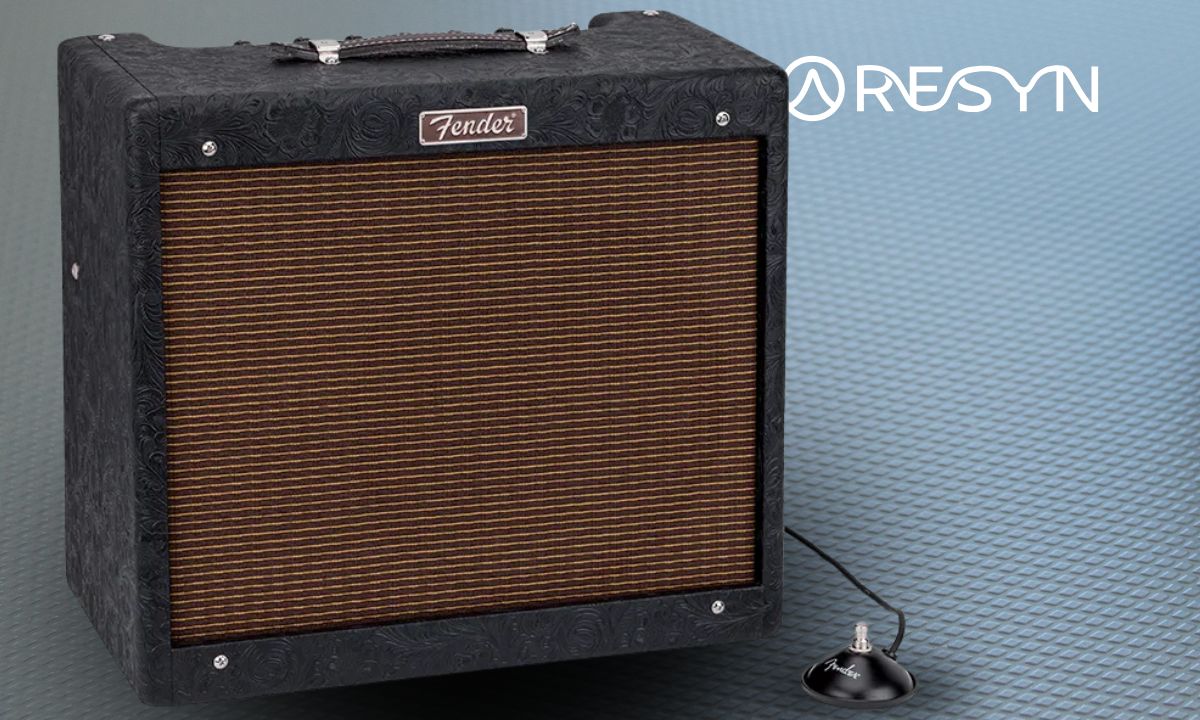
The Fender Blues Junior makes the most sense when you want a compact 1×12 tube combo built around clean headroom, spring reverb, simple controls, and a pedalboard. It makes less sense when you need whisper-quiet power-tube breakup, multiple channels, an effects loop, built-in attenuation, or modern direct-recording tools.
That distinction matters because the Blues Junior name covers more than one amp. A used Blues Junior III, current Blues Junior IV, Lacquered Tweed model, and various Fender Special Run versions can look broadly similar while carrying different speakers, features, prices, and buying considerations.
So don’t start with the question, “Is the Fender Blues Junior good?”
Start with a better one: which Blues Junior are you actually buying?
What the Fender Blues Junior Actually Is
The current Fender Blues Junior IV is a 15-watt, single-channel tube guitar combo with one 12-inch speaker, onboard spring reverb, a three-band EQ, separate Volume and Master controls, and Fender’s FAT mid-boost circuit.
Its tube complement is straightforward: three 12AX7 preamp tubes feed a pair of EL84 power tubes. Fender routes that amplifier through an 8-ohm 12-inch speaker, using a Celestion A-Type in the standard black Blues Junior IV.
This is a deliberately simple amp.
You don’t get separate clean and drive channels. There is no built-in effects loop, onboard digital modeling, USB recording output, selectable power reduction, or elaborate switching system. The Blues Junior instead gives you one basic tube signal path and enough control to move from cleaner sounds toward increasingly driven preamp tones.
That simplicity is a large part of its appeal.
Turn it on, plug in a guitar, set the EQ, add as much spring reverb as you want, and play. If your main tones come from the guitar, your hands, and a pedalboard, there isn’t much menu-diving or signal routing to get between you and the speaker.
Fender Blues Junior IV Specs and Controls
The current standard Blues Junior IV produces 15 watts through a single 12-inch Celestion A-Type speaker. Fender specifies three 12AX7 preamp tubes, two EL84 power tubes, one instrument input, an 8-ohm speaker load, and a cabinet measuring approximately 18 inches wide, 16 inches high, and 9.81 inches deep.
It weighs 31.5 pounds.
The control panel is equally compact:
- Volume
- Treble
- Bass
- Middle
- Master
- Reverb
- FAT switch
Volume controls how hard you drive the preamp section, while Master controls the final output level. That arrangement gives you more flexibility than a single-volume amp because you can introduce preamp drive without immediately running the amplifier at maximum stage volume.
The FAT switch adds a midrange boost. Fender includes a one-button footswitch with the standard Blues Junior IV, allowing you to engage that boost remotely.
None of these controls are unusual by modern standards. Their strength comes from how quickly they let you reach a usable sound without forcing you to manage several channels, modes, presets, or nested features.
What the Blues Junior Sounds and Feels Like
The current Blues Junior IV is best understood as a compact Fender-flavored tube platform rather than a miniature high-gain amplifier.
Fender revised the IV’s preamp circuit for greater definition compared with the previous version and also reworked the spring-reverb circuit. GuitarPlayer’s 2026 hands-on review found the amp strongest when delivering recognizable Fender-style cleans, dynamic breakup, spring reverb, and straightforward pedal compatibility.
That doesn’t mean every Blues Junior sounds identical.
Pickup output, speaker version, guitar volume, pedal chain, room size, and where you set the amp’s Volume and Master controls all influence what you hear. A Telecaster into a mostly clean Blues Junior occupies a very different place from a humbucker-equipped guitar pushing the preamp hard.
Clean Headroom and Tube Breakup
The Blues Junior gives you useful control over where the dirt begins because its Volume and Master controls perform different jobs.
Keep the Volume moderate and raise the Master, and the amp stays cleaner. Increase the Volume and reduce the Master, and more of the overdrive comes from the preamp before the overall output becomes overwhelming.
There is a limit to that trick.
Players sometimes see “15 watts” and assume the amp will behave like a quiet bedroom amplifier when pushed. Tube-amplifier wattage doesn’t work that way. Fifteen watts through an efficient 12-inch speaker can still produce substantial acoustic output, especially when you are trying to move beyond preamp distortion and push the entire amplifier harder.
The Blues Junior therefore works well for players who want clean-to-gritty tube response at practical rehearsal and stage levels. It is much less ideal for someone whose entire goal is saturated output-stage tone while another person sleeps in the next room.
Why Players Use It as a Pedal Platform
The Blues Junior’s simple signal path gives pedals plenty of room to define the rig.
That is especially useful if your gain structure already lives on the floor. Overdrive, distortion, fuzz, modulation, delay, and reverb pedals do not have to compete with complicated channel switching or an amp loaded with preset voices.
The limitation is just as clear: there is no effects loop.
Everything goes into the front of the amplifier. For many players, that is exactly how they intend to use a compact Fender combo. But if your rig depends on placing delays, reverbs, or other effects after substantial amplifier preamp distortion, the Blues Junior’s architecture becomes more restrictive.
Know your signal chain before you buy.
How Loud Is a Fender Blues Junior?
A Blues Junior is loud enough to surprise people who shop by wattage alone.
The 15-watt rating tells you how much electrical output the amplifier produces under defined conditions. It does not tell you that a 15-watt guitar amp sounds one quarter as loud as a 60-watt amp, because perceived loudness, speaker efficiency, cabinet design, frequency response, room acoustics, and distortion all affect what reaches your ears.
In practical terms, the Blues Junior occupies an interesting middle ground.
It is compact enough to carry without treating every rehearsal like a moving job, yet powerful enough that many players use it for rehearsals, small stages, clubs, and miked live work. The same output that makes it useful with a drummer can become the problem at home.
Home Practice
The Master control makes the Blues Junior usable at home. It does not magically turn the amp into a cranked five-watt combo.
You can run the preamp harder and hold the final volume down, which gives you driven sounds without opening the amplifier completely. Clean and lightly driven tones are straightforward at domestic levels as well.
The compromise appears when you specifically want the interaction of the output section, speaker, and room at higher volume.
The Blues Junior IV has no built-in attenuator or selectable low-power mode. If that feature sits near the top of your requirements, buying the Blues Junior and immediately planning a workaround is a sign that another amplifier architecture probably suits you better.
Rehearsals and Gigs
For rehearsals and smaller venues, the Blues Junior’s combination of a 12-inch speaker, 15 tube watts, and manageable cabinet size explains much of its popularity.
GuitarPlayer’s current review describes the IV as a compact, giggable amp, and owner reports regularly describe enough practical output for band use. That does not mean it will maintain unlimited pristine clean headroom beside every drummer, speaker cabinet, or stage setup.
Context matters.
A restrained drummer in a small room presents a different requirement from a hard-hitting rock drummer on an unmiked stage. If perfectly clean headroom at high band volume is non-negotiable, test the amp in that environment instead of assuming the wattage tells the whole story.
Blues Junior III vs IV: What Changed?
The Blues Junior III remains one of the most common versions a used buyer will encounter.
Reverb identifies the standard Blues Junior III generation as running from 2010 through 2017. Like the IV, it uses a 15-watt 1×12 format with three 12AX7 preamp tubes, two EL84 power tubes, spring reverb, three-band EQ, Volume and Master controls, and the FAT circuit.
One of the easiest useful distinctions is the speaker.
The standard Blues Junior III used a 12-inch Fender Special Design “Lightning Bolt” speaker made by Eminence. The standard Blues Junior IV moved to a 12-inch Celestion A-Type.
Fender also revised the IV’s preamp and spring-reverb circuitry. The company describes the revised preamp as providing greater tonal definition and the updated reverb as smoother through its control range.
This does not make every IV automatically better than every III.
A clean, reasonably priced Blues Junior III that sounds good, has been maintained properly, and fits your rig can be a smarter buy than paying considerably more for an IV simply because the Roman numeral is higher.
Used buying changes the equation.
Once condition, speaker replacements, tubes, previous repairs, cabinet wear, local availability, and asking price enter the picture, the best example often matters more than the newest generation.
Standard Blues Junior vs Lacquered Tweed
The Lacquered Tweed Blues Junior deserves separate attention because its differences go past cosmetics.
The current model retains the familiar 15-watt tube platform with three 12AX7s, two EL84s, one channel, spring reverb, and FAT boost. The major hardware distinction is the speaker: Fender fits the Lacquered Tweed model with a 12-inch Jensen C12-N rather than the Celestion A-Type used in the standard black Blues Junior IV.
That matters.
A speaker is not decorative trim. It forms the final mechanical stage between the amplifier circuit and your ears, influencing efficiency, frequency balance, breakup character, attack, and how the amp interacts with a room.
The Tweed model also uses lacquered tweed covering, vintage-style grille cloth, pointer knobs, and a leather-style handle. Fender currently lists the FAT footswitch as optional rather than included with this version, while the standard Blues Junior IV includes its footswitch.
If you are comparing the two used, identify the speaker before paying a premium for the finish.
What the Blues Junior Does Not Give You
The Blues Junior is easier to judge when you stop asking it to be everything.
There is no effects loop. There is no power scaling or built-in attenuation. There is one channel. You do not get cabinet simulation, direct USB recording, IR loading, presets, MIDI control, or a headphone output.
That list sounds severe only if those are features you actually need.
A player who wants an uncomplicated tube combo for guitar, pedals, rehearsals, studio sessions, and smaller gigs may view the absence of those systems as a benefit. Fewer features create a direct workflow.
Someone building a highly routed stereo pedalboard, recording silently at midnight, or switching between pristine cleans and tightly controlled high-gain sounds has a different problem to solve.
Buy for that problem.
How to Inspect a Used Fender Blues Junior
A used Blues Junior needs the same thing every used tube amp needs: identification first, testing second, price judgment last.
Don’t fall in love with tweed, a limited color, or a seller’s description before you know what is actually inside the cabinet.
Confirm the Version and Speaker
Start with the model.
Determine whether you are looking at a Blues Junior III, Blues Junior IV, Lacquered Tweed version, or Fender Special Run. Check the rear labels and visible model markings, then compare them against reliable Fender documentation or established product records.
Next, look at the speaker.
A standard IV is expected to have a Celestion A-Type. A standard III is commonly associated with the Fender/Eminence Lightning Bolt. The current Lacquered Tweed model uses a Jensen C12-N.
A replacement speaker is not automatically a problem. Plenty of guitarists change speakers because they prefer a different response.
It is a valuation factor, though.
Ask what was installed, why it was changed, whether the original speaker is included, and whether any other work accompanied the modification.
Test the Controls, Reverb and FAT Switch
Play through the amplifier before judging cosmetic condition.
Run every control through its useful range and listen for behavior that suggests something needs attention. Check the Volume and Master controls separately. Sweep Treble, Middle, and Bass. Turn the reverb up and down. Engage the FAT circuit.
If a footswitch is included, test it.
Listen at idle as well as while playing. Tube amplifiers are not completely silent devices, but severe noise, intermittent output, unusual crackling, signal dropouts, or controls that repeatedly cut audio deserve investigation before money changes hands.
Do this with more than one cable if possible. Eliminate the easy variables first.
Inspect Tubes, Cabinet and Previous Work
Look through the accessible rear area for obvious physical problems without opening the chassis.
Check the cabinet corners, handle, grille cloth, speaker mounting, power cable, tube retainers where visible, control knobs, input jack, and speaker connection. Ask about drops, liquid exposure, repairs, touring history, storage conditions, and recent tube replacement.
Then stop.
A tube amplifier contains potentially dangerous high voltages, including after it has been switched off. A casual buyer does not need to remove the chassis or probe internal components to perform a useful pre-purchase inspection.
If the amp’s history or behavior gives you a reason to suspect internal work, have a qualified amplifier technician inspect it.
Ask What Is Original
“All original” matters less on a working modern Blues Junior than it does on a collectible 1950s Fender, but originality still affects your buying decision.
Ask about:
speaker, tubes, transformers, reverb tank, cabinet, control components, previous electronic repairs, and modifications.
Tubes are consumable parts, so replacement tubes alone are not a red flag. A good repair is not automatically undesirable either.
What matters is knowing what you are buying.
A documented amp with competent repair work is easier to evaluate than an amp described as “totally original” by a seller who has never looked beyond the control panel.
What Is a Used Blues Junior Worth?
There is no useful permanent answer.
Used values move with generation, condition, variant, speaker configuration, modification history, local demand, shipping cost, and the price of a new Blues Junior at the time you shop.
Start with sold prices, not the most optimistic active listing you can find.
Reverb’s Price Guide is built from completed sales, making it more useful for valuation than a single seller’s asking price. Compare the same generation wherever possible. A Blues Junior III, standard IV, Lacquered Tweed, and limited Fender Special Run do not belong in one undifferentiated price bucket.
Then adjust for the actual amplifier.
A clean IV with its original Celestion, working footswitch, healthy reverb, documented history, and no obvious functional issues belongs in a different comparison set from a road-worn III with an unknown replacement speaker and an intermittent input jack.
[Insert Stat: refresh a September 2026 sold-price range for Blues Junior III, standard Blues Junior IV, and Lacquered Tweed immediately before publication.]
That date stamp matters because a used-buying guide stays honest when it explains the valuation process instead of pretending today’s number will remain correct next year.
New vs Used: When the Price Difference Makes Sense
Fender currently lists the standard Blues Junior IV at $789.99 and the Lacquered Tweed version at $839.99.
Those figures give a used buyer a ceiling, not an automatic target.
A used amp becomes compelling when the discount compensates you for the things a new purchase removes from the equation: uncertain tube life, previous repairs, cosmetic wear, non-original parts, limited return options, and the possibility that you will need technician time after purchase.
A lightly used IV at a meaningful discount is easy to understand.
An older III becomes interesting for a different reason. If its condition is strong and the price is substantially lower, you are still buying the same fundamental 15-watt, 1×12, 3x12AX7/2xEL84 Blues Junior concept without paying for the IV’s revised preamp, reverb voicing, and Celestion speaker.
The decision changes again if the III already has a speaker you love.
This is why used gear resists simple model hierarchies. Condition and configuration can outrank chronology.
Blues Junior Alternatives Worth Comparing
The Blues Junior exists in a crowded part of the amplifier market, so compare it against the features you actually care about rather than collecting a random shortlist of 15-watt combos.
The Vox AC15 is the obvious tonal counterpoint. It occupies a similar compact tube-combo conversation but comes from a different amplifier lineage and responds differently in both EQ and breakup. GuitarPlayer also identifies it as a natural Blues Junior competitor.
The Fender Pro Junior IV goes the other direction.
It is another 15-watt Fender tube combo with EL84 power tubes, but Fender strips it down to Volume and Tone controls, removes onboard reverb, and uses a 10-inch Jensen P10R speaker. It is also physically smaller and substantially lighter than the Blues Junior IV.
If you look at the Blues Junior and think, “I wish this were even simpler,” the Pro Junior deserves attention.
If you look at it and immediately start listing features you wish Fender had included — an effects loop, attenuation, multiple channels, direct recording, headphone use — compare modern designs that include those features instead.
The cheapest amp is rarely the one you buy before replacing it with the amp you actually needed.
Who Should Buy a Fender Blues Junior?
The Blues Junior fits the guitarist who values a recognizable clean-to-gritty tube foundation more than a long feature list.
It makes particular sense for a player who runs several pedals and wants the amp to behave as the stable center of the rig. It also works for musicians who need a genuine 12-inch combo that remains manageable enough to carry between home, rehearsals, sessions, and smaller gigs.
The format is old-fashioned in a useful way.
You control the guitar. You control the pedals. The amp makes them loud.
For a lot of rigs, that’s enough.
Who Should Skip It?
Skip the Blues Junior when your requirements fight its architecture.
If you need power-tube-style saturation at very low room volume, built-in attenuation belongs high on your shopping list. If you depend on post-preamp effects routing, look for an effects loop. If you need channel switching between distinctly different gain structures, one channel is one channel.
The same applies to recording.
Players who need silent headphone practice, USB connectivity, impulse responses, cabinet simulation, presets, or direct digital recording are shopping for a different category of amplifier, even if the Blues Junior’s physical size initially looks right.
Don’t buy a tube combo because you think you are supposed to own one.
Buy it because the limitations make sense for your rig.
Buying a Blues Junior Used on Resyn
The easiest way to shop for a Blues Junior is to apply the same filter to every listing.
Identify the generation. Confirm the speaker. Check visible condition. Ask about repairs and modifications. Verify the footswitch and accessories. Compare the asking price with recent sold examples rather than unrelated active listings.
Then decide whether that exact amplifier solves your problem.
You can browse used amplifiers on Resyn and compare current gear against the buying checks in this guide. If the right Blues Junior is not available, the same process works across other compact tube combos — condition, configuration, use case, then price.
The Best Blues Junior Is the One That Fits Your Volume, Rig and Used Price
The Fender Blues Junior has lasted because the basic idea still works: one portable 1×12 cabinet, 15 watts of tube power, spring reverb, enough clean headroom for pedals, and enough volume for situations well beyond quiet practice.
But the model name alone does not tell you what to buy.
A Blues Junior III at the right price can beat a poor-value IV. A Lacquered Tweed version can make sense because you prefer its Jensen speaker, not because the covering looks vintage. A pristine amp is still the wrong amp when you need an effects loop, silent recording, or power scaling.
Start with the job.
Then choose the Blues Junior that does it.
