

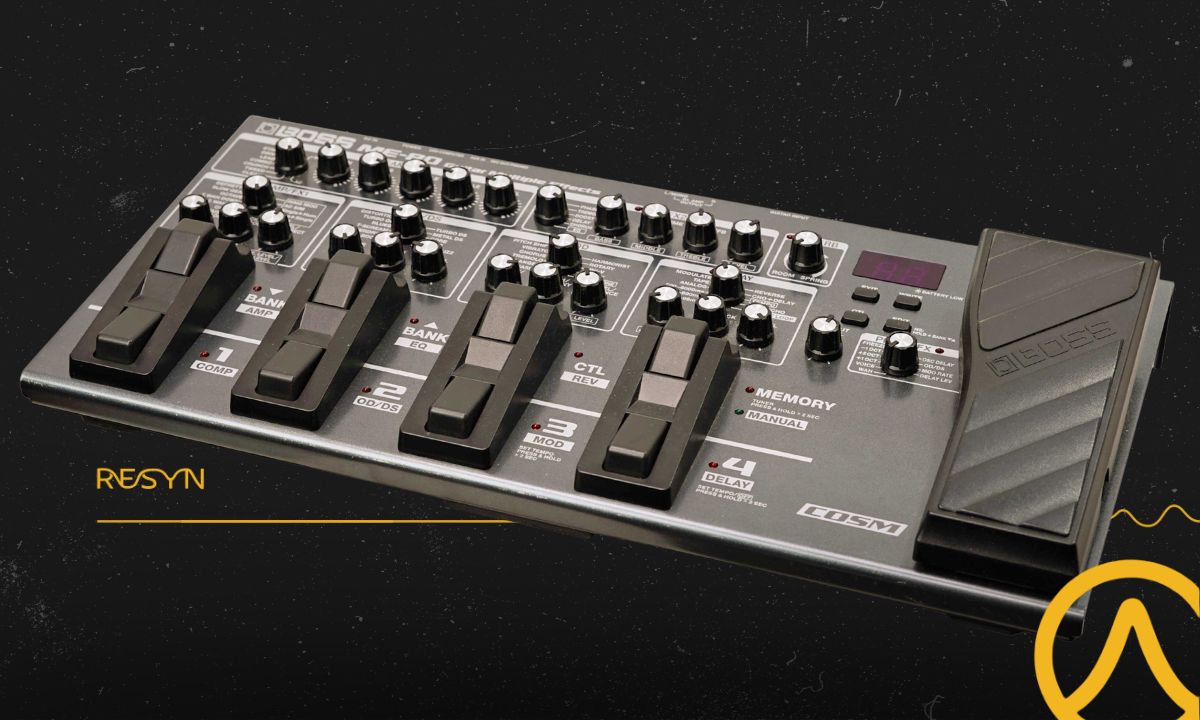
The Boss ME-80 is old enough to be overlooked, but not old enough to be obsolete.
Boss has officially discontinued the ME-80 and replaced it with the ME-90. Yet the older floorboard still does something unusually well: it gives you a large collection of effects, amp models, footswitches, and an expression pedal without burying the useful controls inside menus. Boss built the interface around physical knobs and two distinct operating modes, so it feels closer to a compact pedalboard than a modern touchscreen modeler.
That simplicity is the reason a used ME-80 still makes sense. It is not the right choice if your priority is current-generation amp modeling, impulse responses, sophisticated signal routing, or the newest computer integration. But if you want a rugged multi-effects board that lets you reach down, turn a knob, stomp a switch, and keep playing, its age becomes far less important.
The real question isn’t whether the ME-80 is still “good.”
It’s whether the price, condition, and workflow make sense for the way you actually play.
The Short Answer: Who the Boss ME-80 Still Makes Sense For
A used ME-80 makes the most sense for guitarists who want a lot of conventional guitar effects with immediate physical control.
That includes players building their first serious effects setup, gigging musicians who need a compact backup rig, guitarists tired of scrolling through menus, and anyone who wants one floorboard to handle drive, modulation, delay, reverb, wah, basic amp modeling, looping, and preset recall.
The interface is the key. Boss divided the ME-80 into recognizable effects sections with dedicated knobs, then paired those controls with eight multifunction footswitches and an expression pedal. You can operate it like individual stompboxes in Manual mode or switch entire saved patches in Memory mode.
That makes the ME-80 particularly easy to understand if you already know how a pedalboard works.
The tradeoff is technology.
Boss now positions the ME-90 as the current generation of this format. The newer processor adds AIRD amp models derived from the GT-1000, user-loadable speaker impulse responses, an effects send/return loop, 32-bit floating-point processing, USB-C, and optional Bluetooth functionality.
So the ME-80 isn’t secretly a cheaper ME-90. It is an older platform with a similar control philosophy.
Buy it because that older platform does enough for you, not because the model number is only ten lower.
What the Boss ME-80 Actually Does
The ME-80 combines a conventional multi-effects processor with a control layout modeled after a collection of individual pedals.
Boss specifies eight simultaneous effects categories, COSM amp models derived from the GT-100, eight footswitches, an integrated expression pedal, USB audio/MIDI, battery operation, Tone Studio software support, and a 38-second Phrase Loop.
That feature list sounds like almost every multi-effects sales pitch until you look at how the controls work.
Manual Mode Works Like a Pedalboard
Manual mode is where the ME-80 earns its reputation for simplicity.
Instead of selecting a preset and accepting everything stored inside it, the footswitches control individual effects sections. Dedicated knobs remain visible in front of you, so changing delay time, drive level, modulation depth, or another parameter feels much closer to adjusting a normal stompbox.
Premier Guitar highlighted exactly this distinction in its original hands-on review, describing the interface as unusually familiar to conventional pedal users and noting how quickly the unit could be operated without the menu-heavy friction common to older multi-effects processors.
That still matters.
A newer processor can offer substantially deeper editing while being slower to adjust when you are standing on a dark stage and simply need less delay.
The ME-80 favors immediacy over depth.
Memory Mode Turns It Into a Preset-Based Multi-Effects Unit
Memory mode handles the opposite job.
Instead of switching individual sections, you recall complete patches containing an entire sound setup. That works better when a song requires several coordinated changes at once, for example, moving from a clean rhythm sound into a louder driven lead tone with delay.
Boss designed both workflows into the same hardware.
That makes the ME-80 more flexible than a board that only imitates separate stompboxes. A player can use Manual mode during an open-ended jam or rehearsal, then build repeatable patches for a structured set.
The distinction also matters when buying used. Patch storage and recall need to work properly, not just the effects themselves.
Effects, Amp Models, Expression Pedal, and Looper
The ME-80 covers most of the traditional jobs you expect from a large guitar pedalboard.
Its effects library includes compression, overdrive and distortion, modulation, delay, reverb, pedal-controlled effects, EQ functions, and COSM amp modeling. Boss also built a Phrase Loop function into the delay section with up to 38 seconds of recording.
The expression pedal adds another layer of real-time control. Depending on the selected function, it can handle familiar pedal-style jobs such as wah or volume along with effect parameter control.
You also get USB audio/MIDI, which gives the ME-80 a direct connection to a computer for recording and software interaction. Boss continues to list Tone Studio downloads, Windows drivers, and macOS drivers on the official ME-80 support page, even though the processor itself is discontinued.
That support matters.
But it isn’t a promise that every future operating system will continue supporting a processor designed more than a decade ago.
What Still Holds Up Well
The ME-80’s strongest qualities aren’t particularly fashionable.
That’s part of why they’ve aged well.
The Knob-Based Interface Is Still Unusually Immediate
A deep modeler asks you to think in terms of signal chains, virtual blocks, parameter pages, routing options, cabinets, microphones, snapshots, scenes, and presets.
The ME-80 can do less.
But what it does is sitting directly in front of you.
For a guitarist who understands gain, tone, feedback, delay time, modulation rate, depth, and effect level, the learning curve is unusually shallow. That becomes especially valuable during rehearsals and smaller gigs, where building the theoretically perfect preset matters less than fixing a sound before the drummer counts off again.
Premier Guitar considered ease of use one of the ME-80’s defining strengths when the processor was new. Its review also praised the portability and straightforward relationship between the controls and the sounds they affect.
The hardware hasn’t become harder to understand because newer processors arrived.
The ME-80 Covers a Large Pedalboard’s Basic Jobs
You can replace a surprising amount of conventional floor gear with one ME-80.
Drive, compressor, modulation, delay, reverb, expression effects, amp modeling, a tuner, and looping all live inside the same enclosure. Boss designed eight effect categories to operate simultaneously, which gives you enough breadth for most conventional rock, blues, pop, worship, cover-band, rehearsal, and practice rigs.
That doesn’t mean every effect is equal.
Premier Guitar’s listening tests were particularly positive about several delay and modulation sounds while finding that some heavier distortion tones exposed more obvious digital character.
That distinction still makes more sense than declaring the whole processor either “great sounding” or “dated.”
Multi-effects units are collections of tools. You may love half of them, tolerate another quarter, and never touch the rest.
If the effects you actually use are in the first group, that’s what matters.
Battery Power and the Floorboard Design Still Have Practical Value
Boss designed the ME-80 to run on six AA batteries or an optional PSA-series AC adapter.
Battery power sounds like a minor specification until you need it.
It lets the unit serve as a grab-and-go practice board, a backup effects rig, or a setup for places where convenient power isn’t guaranteed. Premier Guitar specifically called out that portability in its original review and found the enclosure sturdy enough for moving between playing environments.
For a used buyer, though, portability creates one extra inspection point: check the battery compartment carefully for corrosion or damage before buying.
Where the ME-80 Shows Its Age
The ME-80’s weaknesses become clearer when you stop comparing it with individual pedals and start comparing it with current multi-effects processors.
That’s where the generational gap matters.
COSM Modeling Comes From an Older Generation
Boss describes the ME-80’s amp section as updated COSM models derived from the GT-100.
The ME-90 moved to AIRD amp technology derived from the GT-1000 platform, with 24-bit conversion, 32-bit floating-point processing, and user-loadable speaker impulse responses.
Those are meaningful architectural changes.
They don’t make every ME-80 sound bad. They mean the ME-80 belongs to an earlier modeling generation.
That matches the contemporary listening evidence. Premier Guitar found several ME-80 amp and effect sounds convincing while describing some high-gain distortion and other effects as noticeably more digital.
If most of your tone comes from a guitar amp and you’re using the ME-80 primarily as an effects board, that limitation carries less weight.
If you want the processor itself to replace an amplifier, cabinet, pedalboard, recording chain, and direct live rig with modern modeling fidelity, it matters much more.
Routing and Connectivity Matter More in a Modern Rig
The ME-80 handles the essentials: guitar input, outputs, headphones, USB, and standard multi-effects operation.
The ME-90 goes considerably further.
Boss added an effects send/return loop that can place external pedals before or after the amp model, USB-C, optional Bluetooth, user speaker IR loading, and an output mode designed for adapting the processor between guitar amplifiers and full-range systems.
This creates a simple buying rule.
If you want one self-contained floorboard and have no complicated integration needs, the ME-80’s simplicity remains an advantage.
If you’re planning a hybrid rig with external pedals, modern direct tones, IRs, flexible routing, or more advanced computer integration, the ME-90’s extra architecture begins earning its higher price.
Computer Support Is Part of Buying Discontinued Digital Gear
Analog pedals usually age in obvious ways. A switch wears out, a pot gets scratchy, a capacitor drifts.
Digital gear adds software.
As of September 2026, Boss still lists Tone Studio for the ME-80 along with drivers for Windows 10/11 and multiple generations of macOS, including a driver listing for macOS Sonoma 14.x and later.
That’s encouraging for a discontinued processor.
It isn’t permanent insurance.
If USB recording or Tone Studio is essential to your workflow, check Boss’s current driver page against your exact computer and operating system before buying. The hardware can remain perfectly functional as a stand-alone guitar processor even when a future software environment eventually moves beyond it.
Boss ME-80 vs. ME-90: Which One Makes More Sense?
The ME-90 is the ME-80’s direct successor, and Boss explicitly points visitors from the discontinued ME-80 page toward the newer model.
The family resemblance is strong. Both prioritize physical knobs, footswitch control, an expression pedal, battery-powered portability, Manual operation, and stored patches.
The technology underneath them is different.
| Feature | Boss ME-80 | Boss ME-90 |
|---|---|---|
| Status | Discontinued | Current model |
| Amp technology | COSM, derived from GT-100 | AIRD, derived from GT-1000 |
| Physical workflow | Knob-based Manual/Memory modes | Knob-based Manual/Memory modes |
| Speaker IR loading | No user IR loading documented | Three user speaker IRs |
| External effects loop | No comparable send/return loop documented | Send/return with configurable placement |
| USB | USB audio/MIDI | USB-C audio/computer connectivity |
| Bluetooth | No current Bluetooth system | Optional BT-DUAL support |
| Batteries | Six AA | Four AA |
| Phrase Loop | 38 seconds | 38 seconds |
The comparison favors the ME-90 on specifications.
Price changes the answer.
Choose the ME-80 When…
Choose the ME-80 when you want the tactile Boss ME workflow and can buy a clean unit cheaply enough that the missing modern features don’t matter.
That’s especially persuasive if you already use a guitar amp for your core tone and mainly need effects, presets, wah, delay, modulation, drive, and a compact backup rig.
Current Guitar Center used listings provide a useful retail snapshot. In September 2026, multiple ME-80 examples were listed around $199.99, with lower-condition examples around $175-$190.
Those are asking prices from one retailer, not completed-sale values. Still, they show why the ME-80 remains interesting: around that price level, you’re buying a complete floorboard for the cost of a few individual pedals.
Choose the ME-90 When…
Choose the ME-90 when the processor itself needs to carry more of your entire rig.
AIRD amp modeling, IR loading, the effects loop, newer processing architecture, USB-C, and optional Bluetooth give the ME-90 far more room to grow into a direct, hybrid, or computer-centered setup.
The ME-90 also makes more sense when you intend to keep the unit for many years and value the current software ecosystem.
The ME-80 wins on used-value simplicity.
The ME-90 wins on platform capability.
What to Check Before Buying a Used Boss ME-80
A ten-plus-year-old digital floorboard deserves more scrutiny than a photograph of the top panel.
Cosmetic wear isn’t the main concern. Function is.
Test Every Footswitch and the Expression Pedal
Start with your feet.
Cycle every footswitch repeatedly in Manual mode. Switch into Memory mode and confirm that bank and patch changes register correctly.
Then work the expression pedal through its full travel. Test its normal expression function and the toe-switch action if the selected effect uses it.
A worn finish tells you the pedal was used.
A switch that works only eight times out of ten tells you something far more useful.
Sweep Every Knob and Listen for Intermittent Behavior
Turn every rotary control through its range while monitoring the effect it governs.
You aren’t trying to perform an electronics diagnosis. You’re looking for obvious irregularities: parameters that jump unpredictably, controls that fail to register, intermittent operation, or physical damage around shafts and knobs.
The ME-80’s interface depends heavily on direct knob control.
A damaged control matters more here than it does on a processor where you can easily bypass a bad encoder with software editing.
Test Inputs, Outputs, USB, and Power
Plug into the main input and test the outputs you expect to use.
Check the headphone output. If computer connectivity matters, connect the USB port and verify that your computer recognizes the unit using the currently supported Boss driver or software for your system. Boss still maintains ME-80 downloads and documentation, but compatibility varies by operating system.
Test DC power if an adapter is included.
Then open the battery compartment.
A little exterior road rash isn’t scary. Battery leakage and corrosion deserve much more attention.
Save and Recall a Patch
Don’t stop after confirming that sound comes out.
Create a simple patch, save it, move elsewhere, then recall it.
That test confirms an important part of the ME-80’s actual workflow instead of merely proving that its analog input and output stages pass a signal.
Use the tuner.
Run the looper.
Toggle Manual and Memory modes.
A five-minute functional check tells you more than a seller’s “everything works great” description.
Inspect the Physical Controls Before You Judge the Cosmetics
Multi-effects floorboards live near shoes, cables, mic stands, spilled drinks, and hurried load-outs.
Expect scratches.
What you don’t want is impact damage around footswitches, bent controls, loose jacks, an expression pedal that feels mechanically wrong, or obvious evidence that liquid entered the chassis.
A clean-looking ME-80 with intermittent controls is a bad buy.
A scratched one that passes every functional test can be a much better instrument.
How Much Is a Used Boss ME-80 Worth?
There isn’t one permanent correct price.
Current retail asking prices give us a useful reference point. Several Guitar Center ME-80 listings checked in September 2026 sat at $199.99, while fair-to-good condition examples appeared around $174.99-$189.99. Some listings included a power supply, while others explicitly did not.
Treat that as a snapshot, not a price guide carved into the enclosure.
- Check recent completed sales when available, not only asking prices.
- Compare units in similar functional and cosmetic condition.
- Account for an included Boss-compatible power supply.
- Check whether a case, packaging, or other accessories add actual value to you.
- Compare the final price against a used ME-90 and other current multi-effects units.
A cheap ME-80 stops being cheap when the expression pedal is failing, USB is dead, two knobs behave erratically, and you immediately need repairs.
Condition beats a small discount.
If you’re shopping broadly rather than chasing one exact unit, you can also compare current multi-effects pedals and processors on Resyn before deciding where the ME-80 fits against other used options.
Is the Boss ME-80 Good for Gigging, Recording, and Practice?
Yes, but for different reasons in each setting.
Gigging
Gigging is arguably where the ME-80’s control philosophy makes the most sense.
Manual mode gives you individual effect switching. Memory mode gives you repeatable patches. The expression pedal handles real-time control without another piece of equipment, and battery power creates an emergency option when conventional power becomes inconvenient.
Premier Guitar also found the enclosure sturdy and the interface unusually practical for players who need quick adjustments.
Its limitations become more obvious if your live rig depends on modern direct amp modeling, sophisticated external-pedal routing, or current-generation IR-based cabinet sounds.
For a conventional amp-and-effects rig, those issues shrink.
Recording
The ME-80 has built-in USB audio/MIDI, so it can function as a direct computer interface as well as an effects processor.
That makes it perfectly capable of capturing ideas, demos, practice recordings, and finished guitar tracks when you like the tones you’re getting from it.
But recording puts modeling quality under a microscope.
Players who rely heavily on direct amp and cabinet simulation gain more from the ME-90’s AIRD platform and user IR loading.
If your ME-80 track sits correctly in the mix, though, nobody listening to the song gets bonus points for identifying a newer processor.
Practice
Practice is the least complicated use case.
Headphone capability, battery operation, integrated effects, an expression pedal, tuner, preset storage, and a looper turn the ME-80 into a self-contained practice station.
You can explore effects without assembling a board, build song-specific patches, practice transitions between sounds, and loop short passages without adding more hardware.
For a guitarist still learning how effects interact, the visible knobs also make the relationship between a parameter and the resulting sound easier to grasp than a screen full of nested menus.
Who Should Buy a Boss ME-80 Today?
The ME-80 remains easy to recommend when its strengths line up with the buyer.
| Buyer | Fit |
|---|---|
| Stompbox-oriented player wanting one floorboard | Strong |
| Budget-conscious used buyer | Strong at the right price |
| Backup-rig buyer | Strong |
| Beginner who dislikes menu diving | Strong |
| Guitarist mainly using a traditional amp | Strong |
| Modeling-first home recorder | Conditional |
| Player building a complex hybrid routing setup | Weak |
| Buyer wanting the newest Boss modeling platform | Weak |
The mistake is judging it like a current flagship processor.
It isn’t one.
The ME-80 is more interesting as a used tool with a very specific design philosophy: expose the controls, keep the switching familiar, pack a large collection of effects into one road-ready floorboard, and let the player get back to the guitar.
That formula still works.
The ME-80 Still Works When Simplicity Matters More Than Newness
The Boss ME-80 has been surpassed technically. The ME-90 offers newer amp modeling, IR loading, better routing options, a current software platform, USB-C, and features the older processor simply does not have.
But newer and better aren’t the same buying question.
A clean, fully functional ME-80 around the current used-market range gives you a tactile multi-effects board, expression pedal, looper, presets, battery operation, USB recording, and enough conventional effects to cover an enormous amount of guitar work. Its physical interface remains the real attraction, especially for players who want to adjust sounds rather than navigate them.
Test the hardware carefully. Compare the price with newer alternatives. Make sure its routing and computer support fit your actual setup.
If those pieces line up, the ME-80 hasn’t stopped being useful just because Boss stopped making it.
