

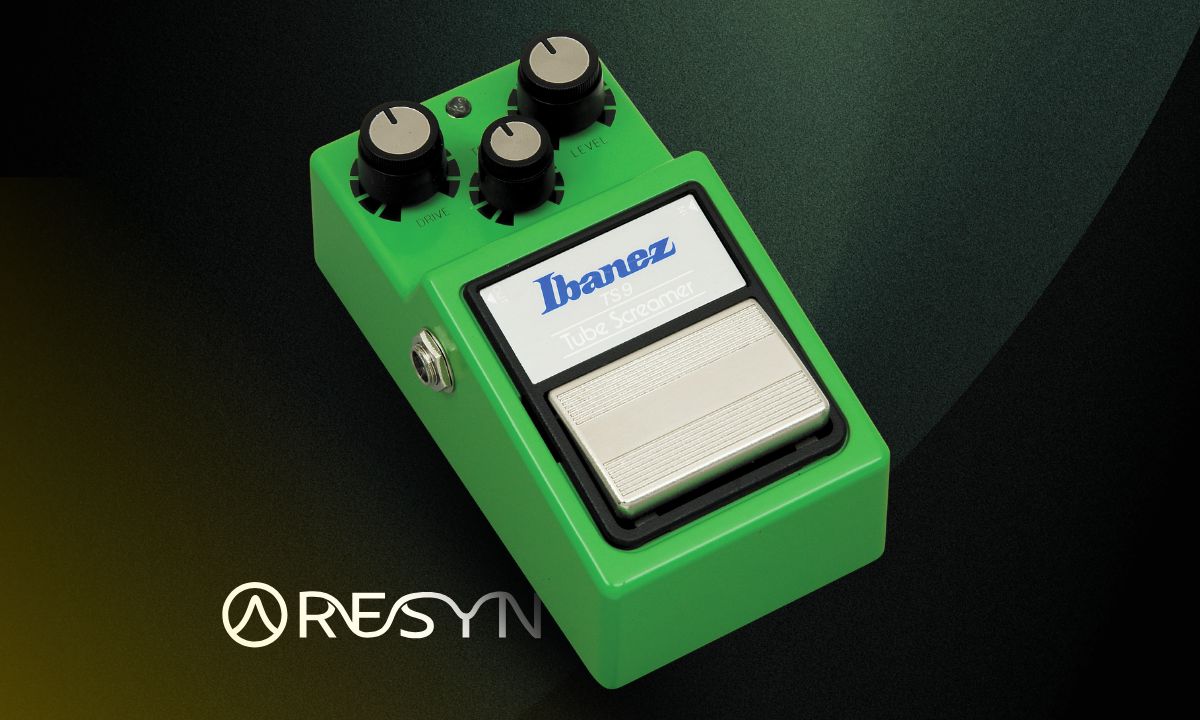
The Tube Screamer is easy to recognize and surprisingly easy to misunderstand.
That little green Ibanez pedal is often described as a warm overdrive, a mid boost, a blues pedal, a solo boost, a high-gain tightening tool, or some combination of all five. Each description contains part of the truth, but none explains why the same basic circuit keeps turning up in rigs that otherwise have almost nothing in common.
The useful answer starts with the rest of your signal chain.
A Tube Screamer shapes the guitar before the next stage receives it. Its characteristic gain structure emphasizes the middle of the guitar’s frequency range while reducing some low-frequency content, and its soft-clipping circuit adds controlled overdrive rather than the harder, more abrupt distortion associated with many distortion pedals.
That combination explains most of the pedal’s enduring usefulness.
Run one into a clean amplifier and it becomes a focused, mid-forward overdrive. Put it in front of an amplifier that is already breaking up and it pushes that existing distortion harder. Feed it into a saturated high-gain amp with the Drive control kept low, and the reduced bass entering the preamp can make palm-muted notes feel tighter and less congested.
Same pedal. Very different job.
So choosing a Tube Screamer is less about finding the “best” green box and more about identifying what you need it to fix.
What Does a Tube Screamer Actually Do?
A Tube Screamer is an analog overdrive pedal built around a frequency-conscious soft-clipping circuit.
The classic design does not simply amplify your entire guitar signal evenly until it distorts. Its gain stage treats frequencies differently, reducing the amount of low-frequency material being driven into clipping while concentrating much of the audible emphasis through the midrange. The clipping diodes sit within the op-amp’s feedback path, producing the softer transition into distortion associated with this circuit family.
That architecture matters more than the green enclosure.
You hear the result as a tighter low end, forward mids, controlled compression and a smoother layer of drive that tends to preserve more note shape than a heavier distortion pedal. Technical analysis of the circuit places a major part of its frequency shaping around the roughly 720 Hz region, which helps explain the recognizable mid-focused response.
The original three controls are simple:
- Overdrive controls how much gain and clipping the pedal produces.
- Tone adjusts the balance of the upper and lower frequencies around the pedal’s characteristic midrange.
- Level controls the signal level leaving the pedal.
Simple controls do not mean one-dimensional results. The balance between Overdrive and Level completely changes how the pedal interacts with whatever comes after it.
Why the Midrange Boost and Bass Cut Matter
Guitar rigs can accumulate low-frequency energy quickly.
Humbuckers, down-tuned guitars, high-gain preamps, large cabinets and multiple gain stages all add opportunities for the lower frequencies to become loose or indistinct. Those frequencies are especially troublesome when they hit distortion, because heavily clipping a bass-rich signal can turn a tight rhythm sound into a broad wall of saturation.
A Tube Screamer changes the signal before that happens.
The reduced low-frequency gain keeps some bass out of the clipping process, while the pronounced mids push the part of the guitar spectrum that carries pick attack, note identity and much of the instrument’s presence.
This is why the famous “mid hump” is not automatically a flaw.
Plug a Tube Screamer into a bright, already mid-heavy rig and the pedal can sound nasal. Use the same pedal with a scooped amplifier, a thick humbucker or a saturated high-gain channel and that frequency contour can solve a real problem.
The amplifier decides whether the EQ curve helps.
Tube Screamer as Overdrive vs Tube Screamer as Boost
There are two fundamentally different ways to use a Tube Screamer.
The first is straightforward: turn up the Overdrive control and let the pedal produce a significant part of the distortion. This works well into a clean or lightly driven amplifier when you want a compact, vocal overdrive sound.
The second approach uses the pedal primarily as a shaped boost.
Keep Overdrive low, raise Level and use Tone to match the amp. Now the Tube Screamer contributes less pedal distortion while sending a louder, tighter signal into the next gain stage.
That second application explains why Tube Screamers appear in rigs that seem far removed from blues or classic rock.
Heavy players are often not asking the pedal for more distortion. Their amplifier already has plenty. They are using the pedal to determine which frequencies reach that distortion and how hard the preamp gets hit.
TS808 vs TS9: The Two Tube Screamers Most Players Compare
The TS808 and TS9 are the two reference points for the entire Tube Screamer family.
They also generate more mythology than their actual circuit differences justify.
Both use the familiar Overdrive, Tone and Level arrangement. Both operate from 9V power in their current standard forms. Both produce the same broad Tube Screamer behavior: soft clipping, tight bass, forward mids and a controllable output level. Ibanez’s current TS808 reissue uses a JRC4558D IC, while the standard TS9 remains the company’s familiar 9-series interpretation.
Historically, their circuitry is extremely close.
Specialist Tube Screamer documentation identifies the principal TS9 change in the output section rather than an entirely different clipping architecture. That helps explain why comparisons often describe the difference as subtle – a slightly different edge, response or smoothness – instead of two radically separate sounds.
Do not build the decision around internet adjectives alone.
Two guitars, two amplifiers and even normal component tolerances can make a larger practical difference than the language usually attached to the model names.
Who the TS808 Makes Sense For
The TS808 makes sense when you specifically want the classic 808 format and its historical reference point matters to you.
It is also the sensible starting point when your idea of a Tube Screamer is the smoother end of the traditional family rather than the slightly sharper reputation usually attached to the TS9.
The important part is expectation.
A current TS808 is still unmistakably a Tube Screamer. It does not suddenly become transparent, full-range or dramatically softer because the enclosure says 808. You still get the characteristic mid focus and low-frequency shaping that define the family.
Buy the TS808 because that version fits the sound, format or lineage you want – not because its model number guarantees better tone.
Who the TS9 Makes Sense For
The TS9 is the practical default for a huge number of players.
It delivers the core Tube Screamer job without asking you to rethink the circuit: mild-to-moderate overdrive when you want the pedal’s gain, or a focused level boost when you want to hit another gain stage harder.
Its current layout remains almost comically simple. Overdrive. Tone. Level. Nine-volt power. Done.
That simplicity is useful when buying used, too.
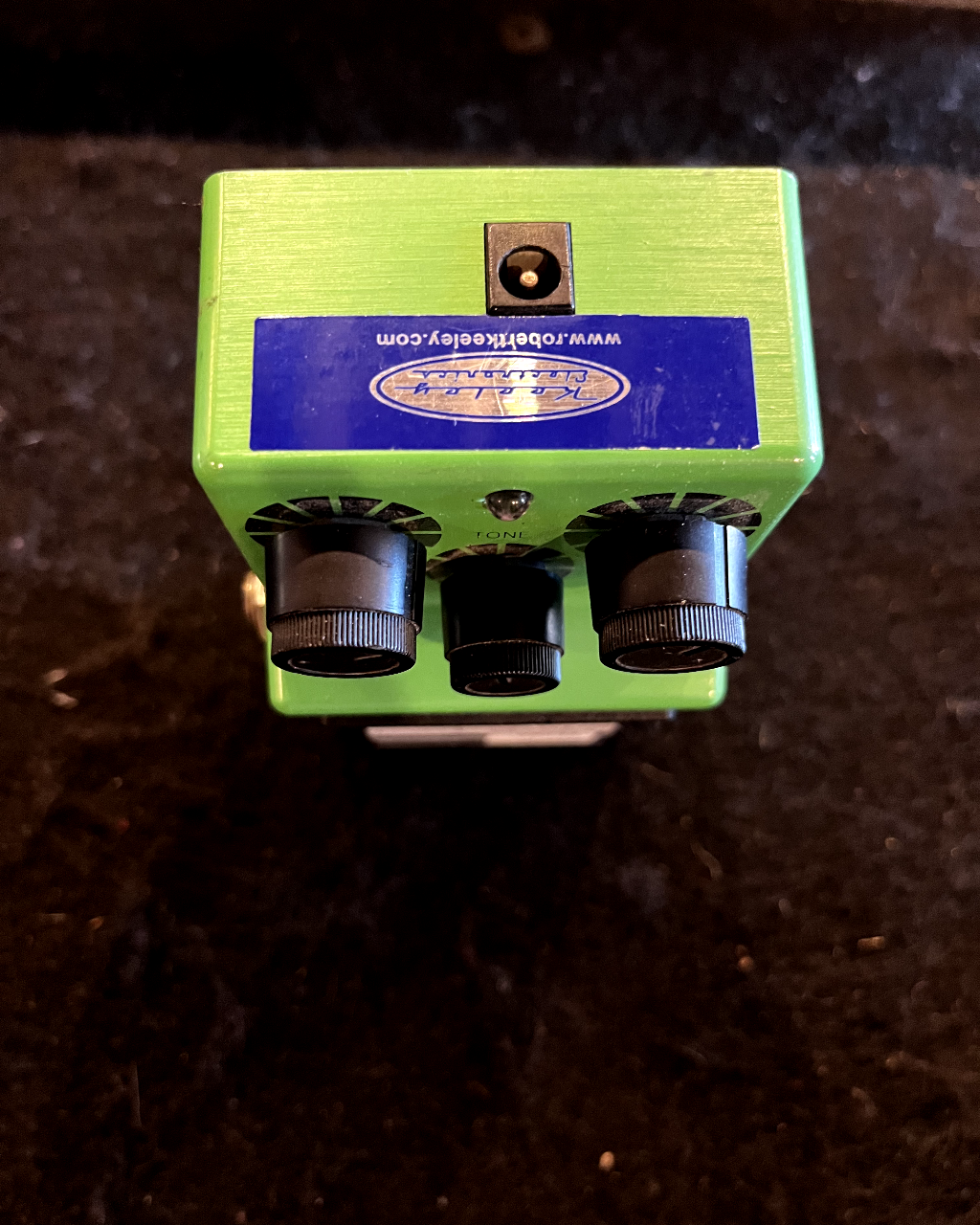
There are decades of TS9 production, reissues and modified examples in circulation, so identify exactly what you are buying instead of assuming every green 9-series enclosure contains an untouched standard circuit.
If you just need the Tube Screamer effect rather than a specific piece of its history, the TS9 is an easy place to start.
Other Ibanez Tube Screamer Models Worth Knowing
The Tube Screamer family is larger than TS808 versus TS9.
Ibanez’s current electronics catalog includes the TS808, TS9, TS9DX, Tube Screamer Mini, TS9B and TS808HWV2 among its active Tube Screamer models. That matters because some of those pedals address limitations of the traditional circuit rather than simply repackaging it.
Tube Screamer Mini
The Tube Screamer Mini attacks the easiest problem first: pedalboard space.
Ibanez retains the familiar Overdrive, Tone and Level controls in a much smaller enclosure. The Mini runs from an external 9V center-negative supply, draws 18 mA and uses true-bypass switching.
That last point distinguishes it from the traditional electronic-switching format players associate with the classic full-size pedals.
For most guitarists, the bigger question is physical rather than philosophical.
If you want the Tube Screamer function, already power your board from a supply and do not need a battery compartment, the Mini removes a lot of real estate without adding unnecessary controls.
TS9DX and Expanded-Range Versions
The TS9DX exists for players who like the TS9 concept but want more low-frequency range.
Ibanez describes it as the same basic TS9 circuitry with additional modes that progressively increase low-end content. Alongside the standard TS9 setting, the mode selector adds +, Hot and Turbo options.
That changes the buying question.
If the standard Tube Screamer feels too lean through your rig, an expanded-range version lets you keep much of the familiar clipping character while relaxing one of the circuit’s defining EQ decisions.
That flexibility is useful with cleaner amps, bass-heavy rigs or players who want the Tube Screamer texture without always removing as much low end.
Hand-Wired and Premium Tube Screamers
The TS808HWV2 pushes the family in the opposite direction.
Instead of adding several voicing modes, Ibanez builds the current HWV2 around hand-wired construction, MOGAMI OFC cabling, true bypass and 9-18V operation. It also adds a final-stage boost that raises maximum output by up to 6 dB.
Those are real, verifiable differences.
They do not prove that the pedal is automatically “better” than a standard TS808 or TS9. Hand wiring, premium components and higher available output describe construction and capability, not a universal preference.
Choose the HWV2 when those features solve something you care about.
Do not buy it simply because a more complicated build must therefore contain more tone.
Tube Screamer Settings That Work as Starting Points
Tube Screamer settings make more sense when you start with the job instead of copying clock positions from somebody else’s pedalboard.
Treat these as starting relationships rather than exact prescriptions:
| Use | Overdrive | Tone | Level | Goal |
|---|---|---|---|---|
| Clean-amp overdrive | Medium | Start near center | Unity or slightly above | Let the pedal provide most of the drive |
| Lead boost | Low | Match the amp | High | Push an already driven amp and bring the guitar forward |
| High-gain tightening | Very low | Adjust for attack | High | Reduce low-end congestion before heavy amp gain |
Your guitar and amplifier determine the final settings.
Clean-Amp Overdrive
With a clean amplifier, turn the Overdrive control high enough for the pedal itself to create the desired breakup.
Set Level around unity at first so you can hear the pedal’s gain and EQ without mistaking extra loudness for better tone. Then use Tone to compensate for the amplifier and speakers.
A bright single-coil guitar into a bright clean combo may need less Tone.
A darker guitar and amplifier combination can take more.
The goal is not to preserve some mythical “correct” noon position. The goal is to make the mid-focused overdrive sit naturally inside your existing rig.
Lead Boost Into an Already Driven Amp
This is classic Tube Screamer territory.
Lower the Overdrive control and increase Level. The pedal now contributes less of its own clipping and sends a stronger, deliberately shaped signal into an amplifier that is already near or beyond breakup.
Listen to the low strings.
If chords become clearer and individual notes step forward without getting much fuzzier, the pedal is doing the job.
Tone then becomes a positioning control. Raise it when the guitar needs more edge and attack. Reduce it when the combination gets spiky or too narrow through the upper mids.
Tightening a High-Gain Amp
High-gain tightening exaggerates the same principle.
Start with Overdrive near minimum, raise Level and let the amplifier remain responsible for most of the actual distortion. The Tube Screamer’s job is to trim low-frequency energy before that signal enters a saturated preamp.
This is not unique to Ibanez.
BOSS describes its SD-1 – a different overdrive using asymmetrical clipping – as useful for adding tightness and definition to high-gain amplifier tones, which illustrates the broader principle: shaping and boosting the signal before heavy distortion can change the feel of the entire gain structure.
If the amp already sounds thin, do not assume more bass removal is progress.
Tight is useful. Small is not.
Guitar, Pickups and Amplifier Matter More Than the Internet Usually Admits
Pedals do not have a tone in isolation.
They have a relationship with the signal arriving at the input and the equipment receiving the output.
A low-output Strat-style single coil produces a different starting signal from a hot bridge humbucker. A clean American-style combo reacts differently from an already compressed British-style gain channel. A modern high-gain amplifier has different needs again.
That is why one guitarist describes a Tube Screamer as clear and focused while another hears nasal compression.
They may both be right.
When a Tube Screamer Sounds Great
A Tube Screamer tends to earn its place when the rig has something the pedal’s EQ can improve.
A scooped clean tone often benefits from more middle presence.
A dark neck pickup can gain articulation.
An amplifier on the edge of breakup can turn the pedal’s extra level into more saturation without needing huge amounts of pedal gain.
A thick high-gain rhythm sound can become quicker and more defined when excess bass is removed before clipping.
Single coils can also work beautifully because the pedal can add density through the middle without demanding a huge increase in distortion.
None of these combinations requires a particular genre.
The pedal is solving frequency and gain problems, not checking whether you play blues.
When a Tube Screamer Sounds Thin, Nasal or Too Compressed
The same EQ can work against you.
Put an aggressively mid-forward overdrive in front of an already mid-heavy amp, then remove more bass from a naturally lean guitar, and the result can collapse into a narrow band of upper-mid information.
That is when people call Tube Screamers nasal.
The answer is not always a different Tube Screamer.
Sometimes the rig needs an overdrive that passes more low end, offers flatter EQ, uses a different clipping structure or gives you independent bass and treble control.
This distinction saves money.
If you dislike the fundamental frequency behavior of the circuit, buying a more expensive version of that circuit does not automatically fix the problem.
Where a Tube Screamer Goes in the Signal Chain
A Tube Screamer usually makes the most sense before the gain stage you want it to influence.
If you want to push an amplifier’s preamp, the pedal belongs before the amp’s input.
If you are stacking it with another overdrive or distortion pedal, order changes the result because the first pedal shapes the signal that reaches the second.
Tube Screamer → distortion means the distortion receives the Tube Screamer’s tightened, mid-focused signal.
Distortion → Tube Screamer means the Tube Screamer receives an already-clipped signal and then applies its own EQ, gain and output behavior afterward.
Neither order is universally correct.
Put the pedal whose character you want to dominate later in the chain, then experiment. If you mainly want the Tube Screamer to tighten a heavier distortion, placing it first is the more logical starting point.
Fuzz requires more care.
Some vintage-style fuzz circuits react strongly to what sits between the guitar and their input, so a Tube Screamer placed before them can change far more than gain level. When a fuzz is highly sensitive to guitar pickup loading and volume controls, start with that fuzz close to the guitar and place the Tube Screamer later.
Tube Screamer Alternatives: What to Choose When You Want Something Different
A Tube Screamer alternative only makes sense after you identify what you want changed.
“Tube Screamer clone” covers everything from near-reproductions to pedals that borrow one stage of the idea and redesign half the circuit around it.
So choose the missing feature first.
If You Want More Low End
Look for a TS-derived pedal with selectable bass response, a lower low-frequency cutoff or dedicated bass control.
Even Ibanez addresses this inside its own family. The TS9DX adds modes specifically intended to increase low-end content, while the TS9B expands the control set for bass players with Mix, Bass, Treble, Drive and Level controls.
That is a more direct solution than trying to EQ back everything a standard Tube Screamer removed.
If You Want Flatter EQ
Move away from pedals whose identity depends on the Tube Screamer’s fixed mid-focused contour.
A flatter drive lets more of the guitar and amplifier’s native EQ remain intact. This is particularly useful when the amp already has the mids you want or when you rely on a broad low end as part of the feel.
“Transparent” is a messy word in pedal marketing.
Think in simpler terms: how much does the pedal reshape the frequency response before you even judge its distortion?
If You Want More Gain or Clipping Options
Choose a design that lets you change the clipping architecture or threshold.
The standard Tube Screamer’s symmetrical soft-clipping arrangement is part of its smooth, compressed identity. An alternative with different diode combinations, asymmetric clipping or selectable clipping modes changes how the waveform transitions into distortion.
BOSS’s SD-1 provides a familiar contrasting example. It retains focused mids and tight bass but uses asymmetrical clipping, giving it a related job with a different clipping character.
The point is not that one architecture wins.
The point is that “more gain” is only one variable. Attack, compression, harmonic structure and EQ are separate decisions.
If You Want the Classic Idea With More Flexibility
Look for controls that address the exact limitation you hear.
Bass switches are useful when the classic low-end cut is too aggressive. Expanded tone controls help when the fixed response fights your amplifier. Clipping options change compression and texture. Higher available output helps when you mainly use the pedal as a boost.
This is where modern TS-inspired designs become more interesting than simple copies.
The classic circuit is already well understood. The useful alternatives are the ones that let you alter its compromises deliberately.
What to Check When Buying a Used Tube Screamer
Used Tube Screamers are simple enough to evaluate, but the model name alone does not tell you what is inside the box.
Start with identification.
Confirm the exact model number, then compare the enclosure, controls, power connection and labeling against known examples from Ibanez. Older pedals, reissues, modern production models and modified units can look deceptively similar in an online listing.
Then check the working parts:
- Footswitch operation
- Input and output jacks
- DC power jack
- Battery connection, when applicable
- Scratchy or intermittent potentiometers
- Loose controls
- Unusual noise
- Signal loss in bypass or effect mode
- Physical damage around the enclosure or jacks
Ask about modifications directly.
Tube Screamers have been modified for decades. Some modifications are professionally executed and desirable to the right buyer. Others are undocumented component swaps inside a pedal advertised as though it were stock.
Neither condition is automatically bad.
The problem is paying stock or collectible money without knowing what you are buying.
Current Resyn inventory already includes standard, older and modified Tube Screamer examples, which makes the distinction more than theoretical. Browse the broader used overdrive and boost inventory on Resyn when you want to compare what is actually available rather than treating one model’s asking price as the entire market.

Vintage, Modified or Standard Reissue?
A vintage Tube Screamer only makes sense at a vintage price when the details supporting that identity are real.
Production period, enclosure details, circuit board, components, previous repairs and modifications all matter more when collectibility enters the purchase.
For a player who simply wants the circuit’s function, a current reissue removes much of that complexity.
And if you are buying a modified pedal, buy the modification intentionally.
Ask who performed it and what changed. A professionally modified TS9 is not a failed vintage example; it is a different tool. The trouble starts when history and modifications become vague sales language.
Which Tube Screamer Fits Your Rig?
Start with the problem.
| Rig / Goal | What the Tube Screamer is solving | Features to prioritize | Starting approach | When to choose something else |
|---|---|---|---|---|
| Clean amp needing warm overdrive | Adds clipping and mid focus | Standard TS808, TS9 or Mini | Moderate Drive, unity-plus Level | You need flatter EQ or more bass |
| Edge-of-breakup amp | Pushes existing amp gain | TS9, TS808, Mini | Lower Drive, higher Level | The amp already has excessive mids |
| High-gain rhythm rig | Removes low-end congestion before saturation | Standard TS circuit | Drive low, Level high | Your amp already sounds lean or sharp |
| Small pedalboard | Adds classic TS function efficiently | Tube Screamer Mini | Set by application | You need battery power or expanded controls |
| Rig that loses too much bass | Keeps TS character with more low-end flexibility | TS9DX or broader TS-style alternative | Start in less aggressive expanded mode | You want genuinely full-range overdrive |
| Player wanting maximum control | Adjusts clipping/EQ rather than accepting the classic fixed recipe | Expanded TS-style design | Tune controls around amp and pickups | Simplicity is more valuable than options |
| Collector or vintage buyer | Historical version and originality matter | Correctly identified example | Verify before buying | You only need the sound |
| Used-gear buyer | Gets the function without paying solely for new condition | Verified TS9/TS808/Mini or known mod | Inspect operation and modification history | Seller cannot clearly identify the pedal |
There is no universal Tube Screamer setting because there is no universal rig.
A Stratocaster into a clean combo asks something different from the pedal than a hot humbucker feeding a high-gain head. The useful question is always the same: what needs to change before the signal reaches the next stage?
Once you answer that, the green box becomes much easier to understand.
The Right Tube Screamer Is the One That Fixes a Specific Problem in Your Rig
The Tube Screamer has survived because its design solves several common guitar-rig problems with three controls and a very recognizable EQ curve.
Use more Drive when you want the pedal itself to create the overdrive. Use more Level when you want to push the next gain stage. Take advantage of the bass reduction when a saturated rig needs definition, and avoid forcing the circuit into rigs where its midrange emphasis makes an already narrow sound even smaller.
TS808, TS9, Mini, DX or something inspired by all of them – the model matters less than the job.
Choose the problem first. Then choose the pedal.
